

What Happens at 2 a.m.: The First 90 Days After Autonomous Resolution Goes Live
A forward-look at the first 90 days after autonomous IT resolution goes live: the quiet queue, the shifted L3 work, and the metrics that actually change.
The decision in front of a CIO on July 1 isn't really about a product demo. The demo already happened. The question is quieter and harder: what does my IT organization actually feel like three months after I flip the switch on autonomous resolution? Not the launch moment, the aftermath. The Tuesday in week six when nobody on the team mentions the queue because there's barely a queue to mention.
This post is a forward-look at that aftermath. It walks through the first 90 days after autonomous IT resolution goes live, what changes in the queue, where the senior work moves, and which metrics actually shift, so the person deciding whether to go live can picture the destination, not just the launch.
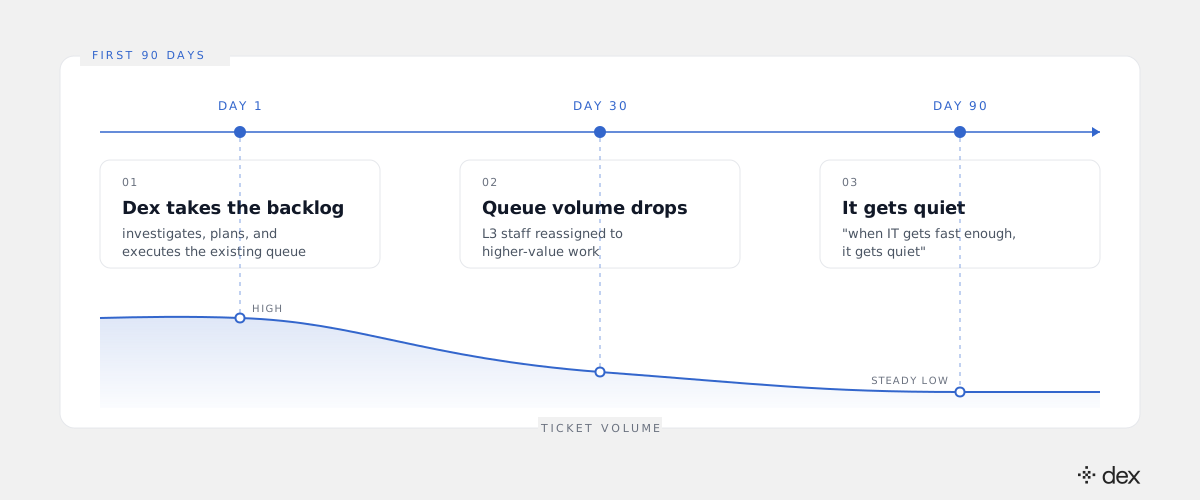
Day 1: the backlog stops being a backlog
The first thing you notice is that the queue starts draining in a direction it has never drained before.
On go-live day, Dex starts working the existing queue alongside your team. It doesn't route the routine requests to a better-staffed shift or reformat them into cleaner tickets. It investigates each one against the live M365 environment, plans the change, and executes it under policy. The password resets, the SharePoint access requests, the MFA recoveries, the license assignments, the onboarding provisioning that had been aging in the queue for hours or days, those resolve in minutes, end-to-end.
The visible effect by end of day is that the backlog shrinks instead of growing. For most teams that's the first time the queue has moved that way during business hours. Your engineers spend day 1 doing something unusual: watching requests close that they didn't have to touch.
What 2 a.m. looks like now
The title of this post is literal. The most underrated change in the first weeks is what happens to your environment when no one is at a desk.
A request that arrives at 2 a.m. used to wait. The user who locked themselves out before an early flight, the remote employee three time zones ahead who can't get into SharePoint before their workday starts, the new hire whose onboarding provisioning didn't complete overnight, all of them used to sit in the queue until someone logged in and triaged the morning pile.
After go-live, those requests resolve while everyone sleeps. Dex doesn't keep office hours. An employee describes the problem in Teams or Slack, and Dex investigates, plans, and executes the fix under policy, then closes the loop. The off-hours queue that your morning shift used to inherit simply isn't there when they arrive. The day starts with project work instead of a triage scramble.
Day 30: the queue gets quiet and the work shifts up
By the end of the first month, two numbers have moved in opposite directions, and that's exactly the signal you want.
Queue volume and average resolution time fall, because routine requests resolve before they age. The benchmark for an agentic IT system resolving routine work end-to-end is 90%+, the target rate Dex measures itself against and the published rate across the customer base. "End-to-end" is the load-bearing phrase: performing the action, under policy, with a full audit trail, not deflecting a user to a knowledge-base article. When 90% of the Tier 1 surface resolves itself, the queue your team sees is a fraction of what it was.
The second number moving is the composition of what's left. Dex resolves L1 through L3 autonomously, not just L1. It handles the routine password and access work and the deeper Tier 2 and Tier 3 troubleshooting, configuration, and engineering-adjacent tasks that used to require a senior tech. So the tickets that still reach a human aren't a random sample of the old queue, they're the genuinely architectural cases, the judgment calls, the security incidents. The work that hits your engineers has shifted up the difficulty curve, even as the volume has dropped.
This is the moment some IT leaders misread their own dashboard. The average handle time on human-touched tickets may rise in month one, and that looks like a regression until you remember why: the easy tickets are gone. Your engineers are only seeing the hard ones now. Higher average difficulty on a much smaller queue is the shape of success, not a problem.
Day 90: the new steady state
By the end of the first quarter, the organization has settled into a different rhythm, and the change is cultural as much as operational.
The queue is quiet. Not empty, the genuinely complex work still flows to people, but quiet enough that your engineers stop organizing their day around it. The reactive-interrupt pattern that defined IT, the steady drip of Tier 1 tickets breaking concentration every twenty minutes, is mostly gone. What replaces it is calendar time: time to build the integrations that were always "next quarter," to harden the security posture, to lead the migration, to review the architecture no one has had a free afternoon to look at in two years.
Cliff DuPuy, Director of IT at Grand Traverse County (an MSP), described what the recovered time was worth in practice: "Dex helped us unlock $67,000 in value in a single day." That wasn't a help-desk-savings number. It was new work the team got to do once the queue stopped owning their attention.
By day 90, the metrics that started moving in month one have stabilized into a new baseline. CSAT is up, because end users get instant resolution inside Teams or Slack instead of waiting hours for a first touch. Escalation rate has found a new floor, the share of work that genuinely needs a human. And the IT team's output, measured in projects shipped rather than tickets closed, is the number that has changed the most, even though it's the one that never appears on the helpdesk dashboard.
What doesn't change: governance and the system of record
For the CIO weighing the switch, the most important reassurance is what stays the same through all 90 days: the safety boundary.
Autonomy here is governed autonomy. Every action Dex takes must match an explicit, structured policy, enforced at the code level rather than as a prompt instruction a clever input could talk its way around. No policy means no action. Dex acts through delegated permissions scoped to the requesting user or admin, never bypasses MFA, and never grants admin roles. The boundary on day 1 is the boundary on day 90, you don't trade control for speed.
Your ITSM doesn't go anywhere either. Dex isn't a replacement for ServiceNow, Jira, or SysAid, it works alongside them. It eliminates the routine requests before they hit the queue and uses your ITSM as the system of record for what's left and for the full audit trail of what was done. If you want the deeper category framing for why this is a different thing from "AI for IT," our explainer on what agentic IT actually means lays it out. The short version: ITSM tracks and routes the work; agentic IT does it.
So what should you watch in your own first 90 days?
If you go live on July 1, three things tell you it's working, and they're not the vanity metrics.
-
Watch average ticket age, not just volume. Volume drops fast and obviously. Age, the time requests sit before resolution, is the cleaner signal that work is resolving rather than just being recategorized. It should fall within the first week.
-
Watch where your senior engineers spend week six. If they're still firefighting Tier 1, something is mis-scoped in policy. If they're in a planning doc for a project that was deferred all year, the shift is real.
-
Watch the audit trail, then widen the scope. Most teams start with a defined policy scope and expand it as they watch what Dex actually did and how. The audit log is where confidence to widen autonomy comes from, read it in month one, and let it tell you where to open up in month two.
The honest summary for the CIO deciding on July 1: the launch moment is anticlimactic on purpose. The change you're buying isn't a dramatic go-live, it's the quiet that arrives a few weeks later, when the queue stops running your team's day and your engineers get to be engineers again. When IT gets fast enough, it gets quiet. The first 90 days are how you get there.
Frequently asked
- What changes in the first week after autonomous IT resolution goes live?
- The first thing that changes is the backlog. In the first few days, Dex works the existing queue alongside your team, clearing the routine requests that had been aging. By the end of week one, the visible queue is smaller and the average ticket age drops sharply, because the requests that used to sit waiting for an available engineer now resolve in minutes. The team's day stops opening with a triage scramble.
- Does autonomous resolution replace IT engineers?
- No. Dex resolves L1 through L3 requests end-to-end, but the genuinely architectural and judgment-heavy work still goes to humans, with full context attached. What changes is the mix: engineers spend far less time on repetitive Tier 1 and Tier 2 work and far more on projects, security posture, and the engineering nobody had time for. Headcount stays; the calendar changes.
- What IT metrics change after go-live, and when?
- Expect queue volume and average resolution time to fall within the first 30 days, because routine requests resolve before they age. Escalation rate and mean-time-to-resolution on the remaining human-handled tickets shift over 30 to 90 days as the work mix moves toward genuinely complex cases. CSAT typically rises because end users get instant resolution inside Teams or Slack instead of waiting hours for a first touch.
- Is it safe to turn on autonomous resolution for an entire M365 environment at once?
- Yes, because autonomy is governed, not open-ended. Every action Dex takes must match an explicit, structured policy enforced at the code level, not as a prompt instruction. No policy means no action. Dex acts through delegated permissions scoped to the requesting user or admin, never bypasses MFA, and never grants admin roles. Most teams still start with a defined policy scope and widen it as they watch the audit trail, but the safety boundary is the same on day 1 as on day 90.
- How does Dex resolve a request without opening a ticket?
- Dex lives natively inside Microsoft Teams and Slack. An employee describes a problem in plain language, and Dex investigates the M365 environment, plans the right sequence of actions, and executes the change under policy, then closes the loop with the user. The work happens before a ticket is ever filed. What reaches your ITSM is the audit record of what was done, not a request waiting in a queue.