

July 1: what changes in IT when autonomous resolution goes live
Autonomous resolution goes live July 1. Here's the before/after of your first 30 days with an autonomous IT engineer, plus what we'll show live.
On July 1, autonomous resolution goes live. Dex, the world's first autonomous IT engineer for Microsoft 365, reaches general availability, and the thing IT leaders have been promised by a decade of "AI for IT" demos finally becomes something you can put on the team. This post is the calendar-anchored version of what that means: a concrete before and after of your first 30 days, the proof behind it, and exactly what we'll show you live on launch day. If you run IT or an MSP, this is the read that tells you what actually changes.
What July 1 actually marks
July 1 is not a product announcement. It's the date a category becomes real.
For years the pitch has been the same: an assistant that drafts a reply, a copilot that suggests a fix, a chatbot that routes a ticket faster. None of them did the work. Dex does. It investigates the M365 environment, plans the right sequence of actions, and executes them under your governance policy, before the request ever becomes a ticket. That is the line between agentic IT and everything that came before it, and July 1 is when it ships to everyone.
Two products go live together. Dex Go lives inside Microsoft Teams and Slack and resolves employee requests in conversation. Dex Pro gives admins a console to run complex operations across M365, Google Workspace, Okta, and any SaaS, with a human reviewing every action. Together they are Dex, and together they cover L1 through L3, not just the easy Tier 1 surface.
Your first 30 days with an autonomous IT engineer
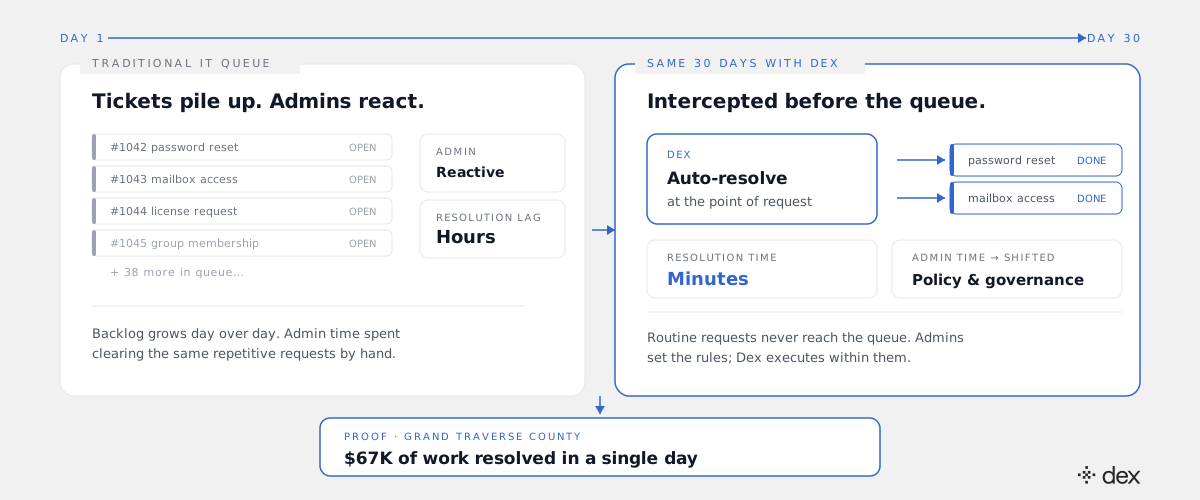
The change you feel first is the queue. It stops growing.
In a traditional month, requests pile up faster than the team clears them. Password resets, MFA recovery, SharePoint access, license assignments, a slow laptop, a broken mailbox rule. Each one waits hours for a first touch and a day or more for resolution, and each one interrupts an engineer who was trying to do real work. The backlog is the baseline. Friday looks worse than Monday.
With Dex running, the shape inverts. Routine requests are intercepted before they reach the queue. An employee asks Dex Go for access in Teams, Dex checks the policy, makes the change, and confirms, in minutes, with no ticket opened. Resolution that used to take hours happens before the user has switched tabs. The cases that do reach your team are the genuinely hard ones, arriving with full context already attached.
The volume that disappears is not just the simplest cases. Dex resolves L1 through L3, so it doesn't stop at password resets and license grants. It takes on the multi-step configuration changes, the deeper troubleshooting, and the engineering-adjacent work that normally consumed your Tier 2 bench. Up to 40 reasoning steps per task means it doesn't give up at the first error the way a scripted bot does. The effect on the queue compounds across all three tiers, not just the bottom one.
By week four the admin job itself has shifted. Time that used to go to reactive firefighting goes to policy and governance: defining what Dex is allowed to do, tightening the rules, reviewing the audit trail, and finally doing the migration and security work that the queue never left room for. The team stops being a help desk and starts being an engineering function again.
The proof: $67K in a single day
The before and after is not theoretical. Cliff DuPuy, Director of IT at Grand Traverse County, put a number on it: Dex helped us unlock $67,000 in value in a single day.
That figure is worth reading carefully, because it isn't a cost-saving estimate. It's new work the team got to do once the queue stopped owning their attention, work that had been deferred or quoted to clients at retail rates. Grand Traverse runs as an MSP, so the recovered capacity converted directly into billable output. The number that matters in evaluating an autonomous IT engineer isn't "how much does this save on Tier 1?" It's "what does the team produce when they aren't doing Tier 1?" Grand Traverse answered that question in a single day.
What we'll show you live on July 8
Everything above is the case for the category. The rest of this post is the invitation.
We're marking general availability with a free live webinar on Wednesday, July 8 at 11:00 AM EST, hosted by Israel Lifshitz, founder of SysAid and Dex, and Hilly Noy, AI Product Lead. No slideware. Three live walkthroughs, in the real product.
Dex Go, no ticket
First, Dex Go resolving an access and troubleshooting request end to end inside Teams. An employee describes the problem in plain language. Dex investigates, confirms the policy allows the change, executes it, and closes the loop. No ticket is opened, no engineer is interrupted, and the whole thing happens in the time it takes to read this paragraph. This is what "before the ticket" looks like when it's running.
A 4-minute onboarding
Second, a real onboarding in the admin center, start to finish, in about four minutes. Branding, so Dex shows up as your IT team. App connections, so it can act across your stack. Skills, the domain modules that tell it how to do the work. And policies, the rules that govern every action. The point of doing it live is simple: real automation in days, not years, starts with setup you can watch happen on a webinar.
Dex Pro, with the admin in control
Third, a Dex Pro walkthrough that answers the question every IT leader asks first: who's in charge here? The answer is you. Dex Pro runs on delegated permissions, the admin's own OAuth token, never a shared key. It shows every action before it executes, with an Approve Always option for bulk work. Every action must match an explicit policy, enforced in code, not in a prompt that can be talked around. No policy, no action. We'll show an admin reviewing, approving, and governing a sequence of real operations across M365 in real time. You can read more about how the employee side fits alongside this in the Dex Go product overview.
For MSPs: grow resolution, not headcount
If you run an MSP, the math is the most direct. Your constraint has always been the same: serving more clients means hiring more engineers, and senior engineers are scarce and expensive. Dex breaks that link. It acts as a senior engineer across every client environment at once, raising the resolution rate you deliver without adding a single seat.
The pricing matches the model. Dex is priced per technician, the people on your team who operate it, at $89 per technician per month billed annually ($107 monthly), with a Max plan at $189 per technician per month billed annually ($228 monthly) for 3x the resolution capacity. Every plan includes the whole product and you can start free for 30 days with no credit card. The client employees Dex helps never need a license, so a small operating team grows resolution capacity across every tenant without a per-seat cost. And because Dex is white-label per client, it shows up as your brand inside each tenant, with isolated databases and encryption keys keeping every environment separate.
The result is leverage that used to be impossible: more clients, higher resolution rates, the same team. For the full breakdown of how this works across a book of business, see how MSPs scale IT support without adding headcount.
Register for July 8
Autonomous resolution goes live on July 1, and the July 8 session is the fastest way to see exactly what that means for your environment before you commit a minute of setup. Wednesday, July 8, 11:00 AM EST, with Israel Lifshitz and Hilly Noy, free to attend. Register for the July 8 launch webinar and bring the queue you most want to make disappear. We'll show you what happens to it.
Frequently asked
- What goes live on July 1?
- July 1 is the general availability launch of Dex, the world's first autonomous IT engineer for Microsoft 365. Both products go live: Dex Go for employees, which resolves requests inside Microsoft Teams and Slack, and Dex Pro for admins, which executes complex M365 operations under explicit policy. We're marking it with a free live webinar on Wednesday, July 8 at 11:00 AM EST, hosted by Israel Lifshitz and Hilly Noy.
- Does Dex only handle Tier 1 tickets?
- No. Dex resolves L1 through L3 autonomously. It handles routine Tier 1 work like password resets, MFA recovery, group access, and provisioning, and it also handles deeper Tier 2 and Tier 3 troubleshooting, configuration, and engineering-adjacent tasks that used to require a senior tech. Only genuine architectural or judgment calls escalate to a human, with full context attached.
- How does an admin stay in control of what Dex does?
- Every action Dex takes must match an explicit, structured policy enforced at the code level. No policy means no action. Dex Pro uses delegated permissions, the admin's own OAuth token rather than a shared API key, shows every action before executing it, and offers an Approve Always option for bulk operations. Everything Dex does lands in both the M365 audit logs and Dex's own activity log.
- How does Dex pricing work for MSPs?
- Dex is priced per technician, the people on your team who operate Dex, not per client and not per end-user. Standard is $89 per technician per month billed annually ($107 monthly), and Max is $189 per technician per month billed annually ($228 monthly) with 3x the resolution capacity. Every plan includes the whole product and differs only in capacity, and you can start free for 30 days with no credit card. The client employees Dex helps never need a license, so MSPs can white-label Dex per client and grow resolution capacity across every tenant without adding headcount or per-seat cost.
- What will the July 8 webinar actually show?
- Three live walkthroughs, no slideware. First, Dex Go resolving an access and troubleshooting request end to end with no ticket opened. Second, a real 4-minute onboarding in the admin center covering branding, app connections, skills, and policies. Third, a Dex Pro walkthrough showing how an admin reviews and controls every action Dex takes. The session is hosted by Israel Lifshitz and Hilly Noy on Wednesday, July 8 at 11:00 AM EST.