

How MSPs Scale IT Support Without Hiring: The Agentic IT Playbook
MSPs are capped by tickets-per-tech economics. Here's how agentic IT lets one tech cover 2-3x the seats and add clients without adding headcount.
Every MSP eventually hits the same ceiling: the number of clients it can serve is capped by the number of tickets its technicians can close in a day. Hire to grow, and margin gets eaten by payroll; hold headcount, and you turn away seats. This post lays out a third path — agentic IT — and the operating math behind why one technician can cover two to three times the seats when routine and mid-complexity work resolves autonomously before it becomes a ticket. It's written for MSP owners and service-delivery leads who've watched the tickets-per-tech wall stop their growth.
The constraint every MSP runs into: tickets-per-tech
The economics of a traditional MSP are governed by a single ratio — tickets per technician per day. A technician can realistically close a fixed number of tickets in a shift, so the seats an MSP can support are a direct function of how many technicians it employs. Win a new client, and ticket volume rises in proportion to seats added. Past a threshold, the only way to absorb that volume is to hire.
That is why MSP growth so often arrives with flat or shrinking margins. Revenue scales with seats, but cost scales with tickets, and tickets scale with seats — so the two lines climb together and the gap between them barely widens. The business gets bigger without getting more profitable. (We walked through the full cost stack behind a single ticket in the IT helpdesk math; the same loaded-cost logic applies per client, multiplied across a book of business.)
The usual levers don't break the ratio. Self-service portals deflect the easiest cases but leave the rest. Cheaper offshore Tier 1 lowers the cost per ticket without lowering the ticket count. Better ticketing software routes work faster but still needs a human to do it. Each of these makes the existing model marginally more efficient. None of them changes the fundamental coupling between seats and headcount.
What agentic IT changes: the input side of the equation
Agentic IT attacks the problem from the other end — it reduces the tickets, not the cost of handling them. Software that doesn't just route IT requests but investigates, plans, and executes the work itself, under explicit policy and with a full audit trail, removes work from the queue entirely. The ratio that capped the MSP — tickets per technician — stops being the binding constraint when most tickets never reach a technician.
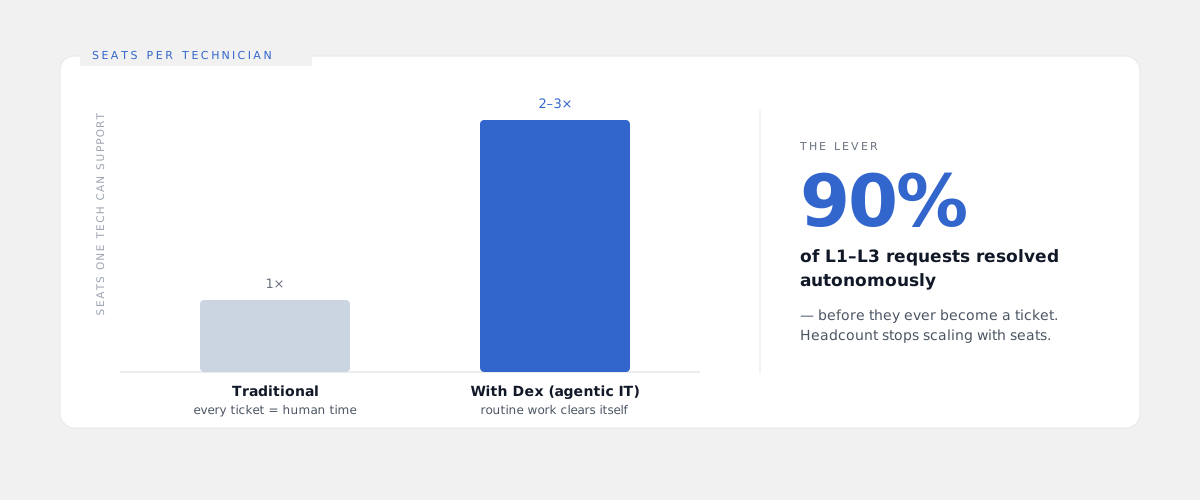
Dex is the world's first autonomous IT engineer for Microsoft 365. It lives inside Microsoft Teams and Slack, and when an employee at one of your clients describes a problem, Dex investigates the environment, plans the right sequence of actions, and executes them — before a ticket is ever opened. The target and observed rate across the customer base is 90%+ of requests resolved autonomously, end-to-end, against the real backend, not deflected to a knowledge-base article.
The decisive detail for MSPs is which work this covers. Dex resolves L1 through L3 — not Tier 1 alone. Routine L1 (password resets, MFA recovery, group and license access, provisioning) resolves autonomously, and so does a large share of the L2-L3 troubleshooting and configuration across Microsoft 365, Entra ID, and Intune that used to demand a senior engineer's time. Only genuine architectural-judgment cases escalate to a human — and when they do, they arrive with full context attached, so the senior tech picks up a half-solved problem instead of a cold one.
The new math: one technician, two to three times the seats
When 90%+ of requests resolve before they become tickets, the tickets-per-tech ratio inverts in the MSP's favor. The technician's day is no longer consumed by the steady drip of routine and mid-tier work. What remains is the small fraction of genuinely complex, judgment-heavy cases — the work a senior engineer is actually worth paying for.
Run it through a simple model. Say a technician can handle a book of 250 seats today, with the day dominated by L1-L2 volume. Remove 90% of that incoming volume and the same technician is no longer the bottleneck on seat count — the residual escalations from 500 to 750 seats fit inside the capacity that routine work used to eat. That's the two-to-three-times coverage figure, and it is not a productivity-pep-talk number. It is a direct consequence of which tickets stop existing.
The leverage compounds because the residual work is higher-value, not just lower-volume. Technicians who aren't resetting passwords all day spend their hours on the engineering, security, and client-relationship work that retains accounts and justifies premium rates. Cliff DuPuy, Director of IT at Grand Traverse County — an MSP — described the effect bluntly: "Dex helped us unlock $67K in value in a single day." That wasn't a cost-saving number. It was work the team finally had the capacity to do once the queue stopped owning their attention.
Multi-tenant by design: running one engineer across every client
An MSP can't adopt an autonomous engineer that treats all its clients as one environment — tenant isolation is non-negotiable, and it's built into how Dex runs. Each client gets per-org isolated databases and encryption keys, so one tenant's data never commingles with another's. There's no shared backend acting as a single point of exposure across your book of business.
Permissions follow the same principle. Dex acts through delegated permissions — the admin's own scoped OAuth token for that tenant — rather than a broad, shared application API key with standing access everywhere. And every action it takes must match an explicit, structured policy: no policy, no action, enforced at the code level rather than as a prompt instruction a clever message could talk its way around. Policies are layered from global down to tenant, department, and individual action, so an MSP can set a baseline once and tune it per client.
For the day-to-day work, the two products map cleanly onto MSP delivery. Dex Go lives in each client's Teams and Slack and handles employee requests, acting only on the requesting user's own account. Dex Pro gives your own admins a console to run complex cross-tenant operations with every action shown before it executes. Together they let a small delivery team operate as a senior engineer across many client environments at once.
Faster client onboarding, wider per-seat margins
The same capability that scales day-to-day support also compresses the most expensive part of taking on a new client: onboarding. Standing up a new tenant is heavy on exactly the work Dex automates — provisioning accounts, assigning licenses, configuring groups and access, applying baseline Intune and Entra ID policy. When that runs autonomously under policy, the calendar time and senior-tech hours that onboarding normally consumes drop sharply, which means an MSP can say yes to a new logo without the usual onboarding crunch.
That flows straight to the margin line. An MSP's revenue is per-seat; its dominant cost is technician hours. Agentic IT decouples the two — seats can grow without headcount growing in step — so the cost of serving each additional seat falls while revenue per seat holds, and the gap that traditional growth couldn't widen finally opens up. The business gets bigger and more profitable, instead of trading one for the other.
A note on what this is not. Dex doesn't replace your PSA or ITSM. It works alongside whatever system of record you bill and report from — SysAid, ServiceNow, Jira, or your PSA of choice — eliminating tickets before they hit the queue and leaving the residual work, with its full audit trail, in the tools your SLAs and invoices already depend on. The ITSM tracks and routes; the agentic engineer does the work. Both jobs still exist; agentic IT just removes the part that never needed a human.
What to do with this as an MSP
If you run an MSP and the tickets-per-tech wall is what's capping your growth, three moves follow from the math above.
First, measure your real ratio. Pull tickets per technician per day and the L1/L2/L3 mix across your book. The share that is routine or mid-complexity — almost always the large majority — is the share an autonomous engineer can absorb, and it tells you how much seat headroom you'd unlock per tech.
Second, ask any automation vendor for end-to-end resolution rate, not containment or deflection. A tool that "contains" a request by pointing the user at a help article hasn't done the work; it's still in your queue tomorrow. The number that moves your economics is the share of requests resolved against the real backend, under policy — and the scope of tiers that resolution covers. L1-only automation barely dents a senior tech's day; L1-L3 is what changes the ratio.
Third, model margin, not just cost. The win isn't a cheaper help desk — it's seats added without headcount added, faster onboarding, and senior techs freed for the high-value work that retains clients. To see that math against your own tenant counts and ticket data, book a demo and we'll sketch it live.
The MSP ceiling was never really about how hard your technicians work. It was about a model that tied every new seat to more human hours. Agentic IT cuts that tie — and once it's cut, growth stops costing you margin.
Frequently asked
- How can an MSP scale IT support without hiring more technicians?
- The constraint on most MSPs is tickets-per-tech: each technician can only close so many tickets per day, so adding clients means adding headcount. Agentic IT changes the input side of that equation by resolving routine and mid-complexity work autonomously — across L1, L2, and L3 — before it ever becomes a ticket. When 90%+ of incoming requests never reach a human, the same technician can cover two to three times the seats, and the MSP grows client count without growing payroll in lockstep.
- Does Dex only handle Tier 1 work like password resets for MSPs?
- No. Dex autonomously resolves L1 through L3, not just L1. That includes routine Tier 1 work — password resets, MFA recovery, group and license access, provisioning — and deeper L2-L3 troubleshooting and configuration across Microsoft 365, Entra ID, and Intune that previously required a senior technician. Only genuine architectural or judgment cases escalate to a human, and they escalate with full context attached so the tech doesn't start from scratch.
- How does agentic IT work across multiple client tenants?
- Dex runs with per-org isolated databases and encryption keys, so each client tenant stays separated rather than sharing one backend. It acts through delegated permissions — the admin's own scoped token — rather than a broad shared API key, and every action must match an explicit policy defined per tenant. That means an MSP can run the same autonomous engineer across many clients while keeping each client's data, policies, and audit trail distinct.
- What does agentic IT do to MSP per-seat margins?
- Per-seat pricing is the MSP's revenue line; technician hours are the cost line. Because agentic IT decouples seat growth from headcount growth, the cost of serving each additional seat falls while revenue per seat holds, which widens margin. The same effect shortens new-client onboarding, since provisioning and access work that used to consume tech hours now resolves autonomously.
- Does Dex replace an MSP's ITSM or PSA system?
- No — Dex works alongside your ITSM or PSA tool rather than replacing it. It eliminates tickets before they hit the queue and uses your system of record for whatever is left, so reporting, SLAs, and billing continue to run through the tools you already use. The ITSM tracks and routes; the agentic IT engineer does the work.