

The IT helpdesk math: why your Tier 1 costs more than you think
What an IT ticket actually costs — including the parts that never show up on the invoice — and what changes when 90% of Tier 1 work resolves before a ticket is opened.
The cost of a single IT ticket is the most underestimated number on the IT budget. The invoice line items — ITSM licenses, helpdesk headcount — show you maybe a third of the real total. The rest is hidden in places the finance team doesn't usually look: user productivity, engineer interruption cost, escalation overhead, the time it takes to get back to flow after each ticket.
This post lays out the actual math. It's the kind of analysis IT leaders need to make the case for change to a CFO who has never read an HDI report — and it's the strongest argument for why agentic IT pays back faster than most automation investments.
What's on the invoice
The published industry benchmarks for the operational cost of an IT ticket — what the help desk literally spends to resolve one — are surprisingly consistent across research firms:
- Tier 1 routine ticket: $20 to $30 per contact, depending on the org and the channel (chat, phone, portal). HDI publishes the most-cited number in the $22–25 range.
- Password reset specifically: as high as $70 when the helpdesk has to make an outbound call to verify the user. Even with self-service, the supported case (user lost MFA, account is locked) carries close to the full Tier 1 cost.
- Tier 2 escalation: $50 to $100 per contact. A meaningful fraction of Tier 1 tickets escalate because the engineer is missing context the user could have provided in the original request.
- Tier 3 / engineering: $150 to $300 per contact, mostly because the senior engineer's loaded cost is significantly higher and the work itself is non-routine.
If you only look at the invoice numbers, an org with 500 employees and ~2,000 IT tickets per year is spending somewhere in the range of $50,000 to $80,000 annually on Tier 1 alone. Real, but not life-changing.
That's the part of the iceberg above the waterline.
What's not on the invoice
The real cost of an IT ticket includes everything that happens outside the ticket system. Three big buckets, all of them larger than the invoice cost.
User wait time. When a user files a ticket for a password reset, they aren't doing their actual job until they get back in. Industry averages put time-to-first-touch on a Tier 1 ticket at 2-4 hours, and time-to-resolution at 8-24 hours for non-trivial cases. At a fully-loaded employee cost of even $50 per hour (conservative for knowledge workers), a 4-hour wait costs the company $200 in lost productivity per ticket — more than the operational cost of resolving the ticket itself.
Engineer interruption cost. IT engineers reporting that they "got nothing done today" usually weren't doing nothing — they were resolving a steady drip of Tier 1 tickets that interrupted deep work. Software engineering research consistently finds that context switches between deep work and reactive tasks reduce engineer output by 20-40%. For an IT engineer making $120K loaded, that's $24-48K of productive output lost per year per engineer, hidden inside what the org thinks is "normal" workload.
Escalation overhead. Every Tier 1 ticket that escalates to Tier 2 carries a context-handoff cost. The escalating engineer summarizes what they tried, the receiving engineer reads the summary, asks the user the same questions again. The longer the escalation chain, the more this multiplies. A ticket that touches three engineers before resolution has paid the operational cost three times and lost half a day of calendar time.
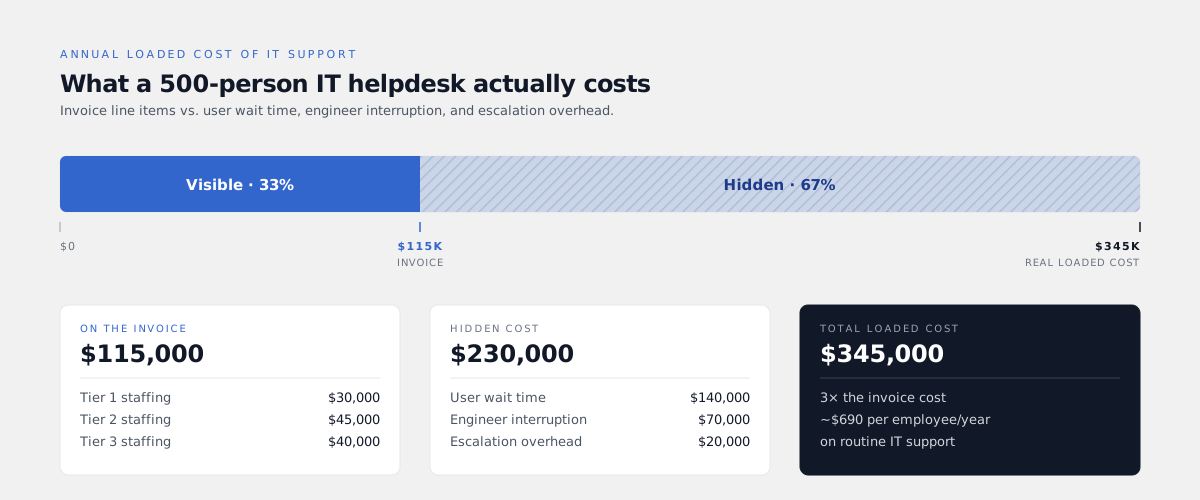
Add it up and the real loaded cost of a Tier 1 ticket — including user time, engineer interruption, and escalation overhead — is typically 3 to 5x the invoice cost. That's the number that matters when you're making the case for automation.
A working model for a 500-person org
Here's a concrete illustrative model. Use real numbers from your own org for the actual case; the structure transfers.
Volume. A typical knowledge-worker org generates around 4 IT tickets per employee per year. For 500 employees: 2,000 tickets/year.
Tier mix. 60% are routine Tier 1 — password resets, group access, license requests, basic device issues. 30% are Tier 2 — multi-step configuration, deeper troubleshooting. 10% are Tier 3 — architecture, novel issues, security incidents.
That's 1,200 Tier 1 tickets, 600 Tier 2, 200 Tier 3.
Invoice cost. At $25 per Tier 1, $75 per Tier 2, $200 per Tier 3:
1,200 tickets  ×  $25   =  $30,000   (Tier 1)
  600 tickets  ×  $75   =  $45,000   (Tier 2)
  200 tickets  ×  $200  =  $40,000   (Tier 3)
                          ────────
                          $115,000  total operational cost
Loaded cost (3-5x the invoice). Conservatively at 3x:
$115,000 × 3 = $345,000
That's the actual cost of IT support for a 500-person org. Most CFOs see $115K. The real number is north of $300K.
What changes when 90% of Tier 1 disappears
The benchmark for an agentic IT system resolving routine work end-to-end is 90%+ — that's the target rate Dex measures itself against, and the published rate across the customer base. "Resolve end-to-end" is the key qualifier here. Deflecting a user to a knowledge base article doesn't count. Filing a better-formatted ticket doesn't count. Performing the action, under policy, with a full audit trail is what counts.
Re-run the model with 90% of Tier 1 resolved automatically.
Tier 1 work that still hits the team: 10% of 1,200 = 120 tickets/year (down from 1,200). These are the cases where the agent escalates because the request is genuinely outside policy or requires human judgment.
Tier 2 work is largely unchanged. Some Tier 2 tickets that used to require an engineer's context can now resolve at Tier 1 by the agent, but the genuinely-complex Tier 2 cases still escalate. Call it 500 instead of 600.
Tier 3 work is fully untouched. Those are the cases that need humans.
New invoice cost:
  120 tickets  ×  $25   =  $3,000    (Tier 1, reduced by 90%)
  500 tickets  ×  $75   =  $37,500   (Tier 2, slight reduction)
  200 tickets  ×  $200  =  $40,000   (Tier 3, unchanged)
                          ────────
                          $80,500   total — a $34,500 reduction
Modest reduction on the invoice line. The compounding effect is in the loaded cost.
New loaded cost (3x):
$80,500 × 3 = $241,500
A $103,500 annual reduction in the real cost of IT support — most of it coming from user productivity recovered and engineer interruptions eliminated, not from the help desk line item shrinking.
That's the gap most CFOs miss when they look at "how much does this tool save us?" The invoice savings are visible. The productivity recovery is two to three times larger and lives in every other team's P&L.
The non-obvious leverage: what engineers do with the recovered time
The most underdiscussed effect of agentic IT isn't the cost reduction. It's what happens to the IT team's calendar.
When 90% of Tier 1 work resolves before a ticket is filed, your engineers stop being a help desk. They stop spending the day in reactive mode. They get back the time to do the work that actually moves the org forward — building integrations, hardening security posture, leading the next migration, reviewing the architecture nobody has had time to look at in two years.
Cliff DuPuy, Director of IT at Grand Traverse County (an MSP), described what this looked like in practice: Dex helped us unlock $67,000 in value in a single day. That wasn't a productivity-improvement number. That was new work the team got to do — work that had been deferred or quoted to the customer at retail rates — once the queue stopped owning their attention. Multiply that across a year and the recovered-time number is often larger than the cost-reduction number.
The right way to evaluate an agentic IT investment isn't "how much does this save on Tier 1?" It's "what does the IT team produce when they aren't doing Tier 1?"
What the deflection rate has to look like to matter
A productive note on diligence: deflection-rate claims are not interchangeable. Three numbers a vendor might quote are very different things.
Containment rate — the share of requests that don't escalate to a human, regardless of whether the user got a useful answer. This is the easiest number to inflate. A chatbot that responds "I'm not sure, please try the knowledge base" has 100% containment and 0% resolution. Skip this number.
Self-service rate — the share of users who resolve their own issue through a portal or tool. Useful, but credit belongs to the user, not the software. Most orgs already have an SSPR rate of 30-50% before any AI investment.
End-to-end resolution rate — the share of incoming requests the system resolves itself, against the real backend system, under policy. This is the only number worth comparing across vendors. When you ask, ask specifically for this one.
Dex's number is 90%+ end-to-end on the Tier 1 surface. Any tool quoting better than that is either measuring containment or counting differently.
What to do with this
If you're an IT leader making a case to a CFO, three points usually carry the conversation:
-
The invoice cost is a small share of the real cost. Show them the 3-5x multiplier and the productivity-recovery line. Most CFOs have never seen this math written down. Once they see it, the ROI argument shifts from "$30K saved on the help desk" to "$100K-plus in recovered organizational output."
-
Ask vendors for end-to-end resolution rate, not containment. This filters out the chatbots and copilots that dominate the "AI for IT" pitch deck circuit. If a vendor can't answer this question cleanly, they're not solving the work, they're routing it.
-
The bottleneck shifts from labor to policy. Once 90% of Tier 1 is automated, the limiting factor isn't engineer hours — it's how well-defined your policies are. Time to invest in clean policy authoring becomes the new project. That's a much better problem to have.
For the methodology behind how Dex measures resolution and what's in the 90% number, see our technology overview. For a working session on what this model looks like against your specific environment and ticket data, book a demo — we can sketch the math live.
The IT helpdesk isn't a cost center because IT is wasteful. It's a cost center because the work is wasteful — repetitive, interrupting, hidden across two budgets at once. Agentic IT doesn't make the help desk cheaper. It removes the work that didn't need a human in the first place.
Frequently asked
- How much does an IT ticket cost?
- Published industry benchmarks put the average cost of a Tier 1 IT contact between $20 and $30, and password-related tickets specifically as high as $70 when the helpdesk has to call the user back. Those numbers cover the operational cost — staff time, ticket-system overhead, escalation routing. They do not include the cost of the user's wait time, which often exceeds the operational cost when measured against fully-loaded employee hourly rates.
- What's the ROI of IT automation for Tier 1 work?
- The ROI depends on three numbers: ticket volume, average loaded cost per ticket, and the percentage of tickets the automation actually resolves end-to-end (not just deflects to a self-service page). For a 500-employee organization running ~2,000 IT tickets per year with ~60% Tier 1, an agentic IT system resolving 90% of routine work translates to roughly $32,000 a year in direct operational savings, plus user productivity recovered. The exact figure scales with org size; the structure of the math does not.
- What counts as a Tier 1 IT ticket?
- Tier 1 work is routine, policy-bounded, and resolvable without architectural judgment. The standard buckets are: password resets and account unlocks, MFA recovery, group and license access, software provisioning, basic device troubleshooting, simple configuration changes, knowledge-base lookups. Together they typically account for 60-80% of total IT ticket volume in a Microsoft 365-centric organization.
- Why doesn't self-service password reset (SSPR) solve this already?
- SSPR resolves the simplest password case — the user remembers their MFA and resets cleanly. It does not handle MFA loss, account lockouts after repeated failures, password resets that require manager approval, or anything involving Conditional Access policy interactions. SSPR typically covers about half of the password reset queue, and password resets are only one slice of Tier 1. The remaining work still hits the IT team.
- How does Dex calculate ticket deflection?
- Dex measures deflection as the percentage of inbound requests it resolves end-to-end without escalating to a human — that is, requests that the agent investigates, plans, executes the change for, and closes with a full audit trail. Across the customer base, that number sits at 90%+ of the Tier 1 surface (password resets, group access, license assignments, software provisioning, basic device troubleshooting, etc.). Cases that need human judgment escalate cleanly with full context attached.