

Cost Per Resolution vs Cost Per Seat: The Pricing Model IT Has Been Missing
Cost per resolution ties IT support spend to outcomes instead of headcount. Why per-seat licensing hides waste, and how the math changes at $1.99.
Every IT buying committee asks what a tool costs per user. Almost none ask what it costs per outcome. That gap is where most IT software budgets quietly go to waste: you pay a fixed per-seat fee for every employee in the directory, including the 60% who will not raise a single IT issue this year, and the price you pay is completely disconnected from the amount of work the software actually did.
Cost per resolution is the alternative. It is a unit economic, not a license: you pay a fixed amount each time an issue is fully resolved, and nothing when it isn't. This post lays out how the two models compare on the same org, where each one is genuinely the right choice, and what changes in a vendor conversation once you start asking for a price per outcome instead of a price per head.
What cost per resolution actually measures
Cost per resolution is the total spend required to take one IT issue from raised to closed, divided across the issues that actually closed. It is the number your CFO would ask for if IT support were a manufacturing line.
Three things make it a more honest metric than the alternatives:
It only counts completed work. A ticket that bounced between two engineers and got closed as "user resolved it themselves" does not count as a resolution. Neither does a chatbot answer that sent someone to a knowledge base article.
It normalizes across volume. Two organizations with wildly different headcounts can compare cost per resolution directly. Cost per seat tells you nothing about whether the money bought anything.
It exposes tier economics. Once you measure per resolution, you can see that a password reset and an Exchange Online mail flow investigation are not the same product, and price your automation decisions accordingly.
For the full breakdown of what a single IT ticket costs once you include user wait time and engineer interruption, see the IT helpdesk math behind Tier 1 costs. The short version: published benchmarks put the operational cost of a routine Tier 1 contact at $20 to $30, and the fully loaded cost is typically three to five times that.
Why per-seat pricing became the default
Per-seat pricing did not win because it reflects value. It won because it was easy to bill in 2010.
SaaS vendors needed a metric that was countable, predictable, and grew with the customer. Seats were sitting right there in the directory. The model made real sense for tools where every seat is an active user every day: email, CRM, collaboration, an ITSM console that agents live inside. For those, availability is the value, and per-seat is a fair proxy for it.
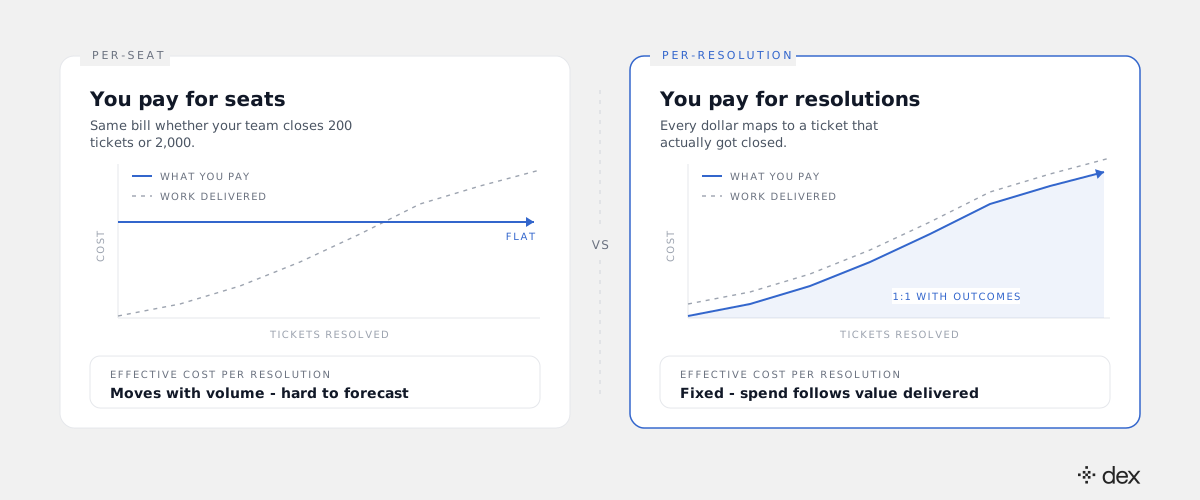
IT support automation is not that kind of tool. The value is not that it is available to 500 people. The value is that it closed 1,800 issues. Charging per seat for it is like paying your electrician a monthly retainer per room in the building.
The silent-seat problem
Ticket volume in any organization is heavily skewed. A minority of employees generate most of the requests, driven by role, device churn, and access complexity. Under per-seat pricing you pay the same rate for a warehouse worker who has never opened a ticket as for a finance analyst who needs a new SaaS permission every week. The vendor's revenue is indexed to your HR headcount, which is a number neither of you can influence through good work.
The same organization, priced two ways
Take a 500-employee organization generating around 4 IT issues per employee per year: 2,000 issues annually. Dex resolves L1 through L3 end to end, at a target rate of 90%+, which puts roughly 1,800 issues a year in scope.
Per resolution, at $1.99:
1,800 resolutions  ×  $1.99  =  $3,582 / year
                                ($7.16 per employee, per year)
Per seat, at $5 per user per month:
500 seats  ×  $5  ×  12  =  $30,000 / year
                            ($60.00 per employee, per year)
Same organization. Same work performed. An 8x difference in spend, entirely explained by which unit the invoice is denominated in.
Find your break-even volume
The useful way to run this comparison is to solve for the crossover instead of arguing about list prices. At $1.99 per resolution, that 500-seat organization would need Dex to resolve about 15,000 issues a year, roughly 30 per employee, before per-resolution pricing costs as much as a $5 per user per month license. That is seven times the ticket volume a typical knowledge-worker org actually generates.
Do this arithmetic with whatever per-seat number you have been quoted. Divide the annual license total by $1.99. The result is the number of resolutions the seat-based model is implicitly betting you will need. Then compare it to your real ticket count. In most cases the gap is not a rounding error, it is the majority of the contract.
The part per-seat pricing can't price: complexity
Here is the asymmetry that makes per-resolution pricing genuinely different rather than just cheaper.
Dex investigates the environment, plans the change, and executes it under your policy, across L1 through L3. A password reset is $1.99. An MFA recovery that has to reconcile a Conditional Access policy is $1.99. A multi-step Intune configuration fix that would have taken a senior engineer 40 minutes is $1.99. The price does not move with the difficulty of the work.
Under human staffing, the opposite is true: cost per resolution climbs steeply with tier, because a Tier 3 contact carries a senior engineer's loaded hourly rate. Under per-seat software pricing, complexity is invisible to the invoice in the other direction, you pre-paid for capability you may never use.
Flat per-resolution pricing means your cheapest resolutions and your most expensive ones converge to the same number. The harder the work Dex takes off your team, the better the deal gets. That is the incentive alignment per-seat licensing cannot reproduce: the vendor only earns when the work is finished, and every unfinished attempt is free.
Where per-seat is still the right model
Being fair about this matters, because a pricing argument that only works in one direction is a sales pitch, not a framework.
Per-seat is right for systems of record. Your ITSM is used by every agent every day, and what you are buying is a durable, always-available record. SysAid, ServiceNow, and Jira Service Management are correctly priced per seat. Dex is not a replacement for any of them; it removes the work before a ticket is filed and leaves the ITSM as the record for what remains.
Per-seat is right when volume per user is very high and stable. If your environment genuinely generates 30-plus IT issues per employee per year, a fixed license may well come out ahead. Run the break-even math rather than assuming.
Per-seat is easier to forecast. A fixed line item is simpler to defend in a budget cycle than a variable one. The honest counter is that IT volume is among the more predictable numbers in the business, and that with per-resolution pricing an unfinished task does not bill at all, which bounds the downside.
What this changes for MSPs
For an MSP, cost per resolution is not a procurement detail. It is the margin instrument.
MSPs sell against a contracted price per endpoint or per user, then absorb whatever ticket volume shows up. Every resolution has a real cost, and the gap between contracted revenue and delivery cost is the entire business. A per-seat automation license is a fixed cost applied across every user in every tenant, whether that tenant is quiet or on fire. It dilutes margin on your best accounts to subsidize your worst.
A per-resolution cost sits directly against the ticket that generated it. You can see, per tenant, exactly what automation cost you and what it displaced. Cliff DuPuy, Director of IT at Grand Traverse County, an MSP, put the effect in outcome terms: "Dex helped us unlock $67K in value in a single day." That value was work the team could suddenly deliver, not a line item they cut. When your cost per resolution drops to a couple of dollars, taking on the next tenant stops being a hiring decision.
How to run this comparison yourself
Four steps, and you can do it in a spreadsheet before your next vendor call.
- Count real resolutions, not tickets. Pull the last 12 months from your ITSM and exclude anything closed without action. That denominator is the one that matters.
- Calculate your current cost per resolution. Total support spend divided by that count, split by tier if you can. Most teams find a number between $25 and $75 for routine work once loaded cost is included.
- Convert every quote to cost per resolution. Annual license total divided by your resolution count. Now every vendor is denominated in the same unit, and per-seat quotes stop being incomparable.
- Ask each vendor for their end-to-end resolution rate. A price per outcome is meaningless without a defensible definition of the outcome. Containment and deflection rates are not the same thing.
Per-seat pricing asks how many people might need IT. Per-resolution pricing asks how much IT actually happened. Only one of those questions has an answer your CFO can act on.
Dex is $1.99 per resolution, charged only when the issue is fully resolved, with $100 in starting credit (about 50 resolutions) and no credit card required. For the mechanics of how a resolution gets investigated, planned, and executed under policy, read how Dex works end to end.
Frequently asked
- What is cost per resolution in IT support?
- Cost per resolution is the total amount your organization spends to fully close one IT issue, from the moment it is raised to the moment the user is working again. It is calculated by dividing all support spend (staff time, tooling, escalation overhead) by the number of issues actually resolved. Unlike cost per seat or cost per ticket, it only counts finished work, which makes it the closest thing IT has to a unit economic.
- How do I calculate cost per resolution for my helpdesk?
- Take your annual support spend and divide it by the number of issues your team resolved in the same period. Include helpdesk salaries, ITSM and tooling licenses, and a realistic share of escalation time from senior engineers. Published benchmarks put the operational cost of a routine Tier 1 contact between $20 and $30, and the fully loaded cost including user wait time is typically three to five times higher. Run the number for each tier separately, because a Tier 3 resolution can cost ten times a Tier 1.
- Is per-resolution pricing cheaper than per-seat pricing?
- It depends entirely on volume per employee. Per-seat pricing is a fixed cost that ignores usage, so it gets cheaper per resolution the more issues you have and more expensive the fewer you have. At Dex's $1.99 per resolution, a 500-employee organization would need roughly 15,000 resolutions a year (about 30 per employee) before matching what a $5 per user per month license would cost. Most knowledge-worker organizations generate closer to 4 IT issues per employee per year.
- How much does Dex cost?
- Dex costs $1.99 per resolution. There are no seats, no subscriptions, and no minimums. You are charged only when Dex fully completes the issue or task, and every new account starts with $100 in free credit (about 50 resolutions) with no credit card required. A password reset and a multi-step Microsoft 365 configuration change both cost the same $1.99.
- Doesn't usage-based pricing make my IT budget unpredictable?
- Usage-based pricing moves your bill with your ticket volume, which is a real change for a team used to a fixed license line. Two things make it forecastable: IT volume is one of the more stable numbers in the business (it tracks headcount and change events, not seasonality), and unfinished work does not bill, so the worst case is bounded by how many issues you actually have. Running against the $100 starting credit for a month gives you a measured rate before you commit to a budget line.
- Does per-resolution pricing replace my ITSM license?
- No. Per-seat licensing is a reasonable fit for a system of record like SysAid, ServiceNow, or Jira Service Management, because every agent uses it every day and its value is availability rather than throughput. Dex works alongside your ITSM: it resolves the issue before a ticket is opened, and the ITSM remains the record for what is left. You are buying two different things, and they should be priced two different ways.