

The 15-Second Relay: Whether Your Champion Can Explain Agentic IT Without You in the Room
How to explain agentic IT to stakeholders in one sentence your champion can repeat — and why 69% of buyers hit a message mismatch without it.
Most of an agentic IT purchase is decided in rooms the vendor is never invited to. Gartner's B2B buying research puts the share of the purchase cycle buyers spend with all potential suppliers combined at about 17% — split across a three-vendor shortlist, that's roughly 5% each. The other 95% is internal: a steering committee, a security review, a hallway conversation between the CIO and the CFO, a Slack thread nobody archives.
In every one of those rooms, your champion is the only spokesperson the product has. Whatever sentence they use is the pitch. And with 2026 B2B buying research putting 87% of enterprise purchases at four or more stakeholders, that sentence gets relayed secondhand and thirdhand before it reaches the person who signs.
So the real question in an agentic IT evaluation isn't whether the demo landed. It's whether the champion can explain, in fifteen seconds and without you in the room, what the thing actually does — in words that survive being repeated by someone who never saw the demo.
The 17% problem: your pitch is a relay, not a presentation
A sales conversation is a controlled environment. You get to clarify, handle objections, read the room, and correct a misunderstanding the moment it appears. None of that is available in the 95%.
What happens instead is a relay. The champion hears your pitch. They compress it into a sentence for their manager. The manager compresses that into a phrase for the security lead. The security lead carries a version of that phrase into a committee meeting. Each hop is a compression step, and compression is lossy in a predictable direction: toward the most familiar category available.
That direction is the whole problem. "Autonomous IT engineer that resolves L1 through L3" is unfamiliar. "AI chatbot for the helpdesk" is familiar. When a stakeholder can't hold the precise version, they don't hold a blank — they substitute the nearest known thing. And the nearest known thing for anything with "AI" in it is a chatbot, which every one of those stakeholders has already seen fail.
The deal doesn't die from objection. It dies from downgrade.
What message drift actually costs
Two 2026 findings put a number on this.
Gartner's 2026 buyer research found 69% of buyers reported a mismatch between what a vendor's website said and what the vendor's sales team said. That's not a rounding error; that's the default experience. And separately, the multi-stakeholder finding — 87% of purchases involving four or more people — means every mismatch gets compounded across four interpretations rather than corrected by one conversation.
Here's the part most vendors get wrong about that 69%. A buying committee that encounters two versions of a story doesn't stall to figure out which is true. It resolves the contradiction the cheapest way available: it picks the smaller, safer interpretation. The version that's easier to approve. The version that requires less explanation to the CFO. Which is almost always the version that undersells what the product does — and prices it accordingly.
Message drift doesn't confuse buyers. It reclassifies you.
How to explain agentic IT to stakeholders: the relay sentence
A sentence that survives a relay has four parts, and each one is doing a job for a different seat on the buying committee.
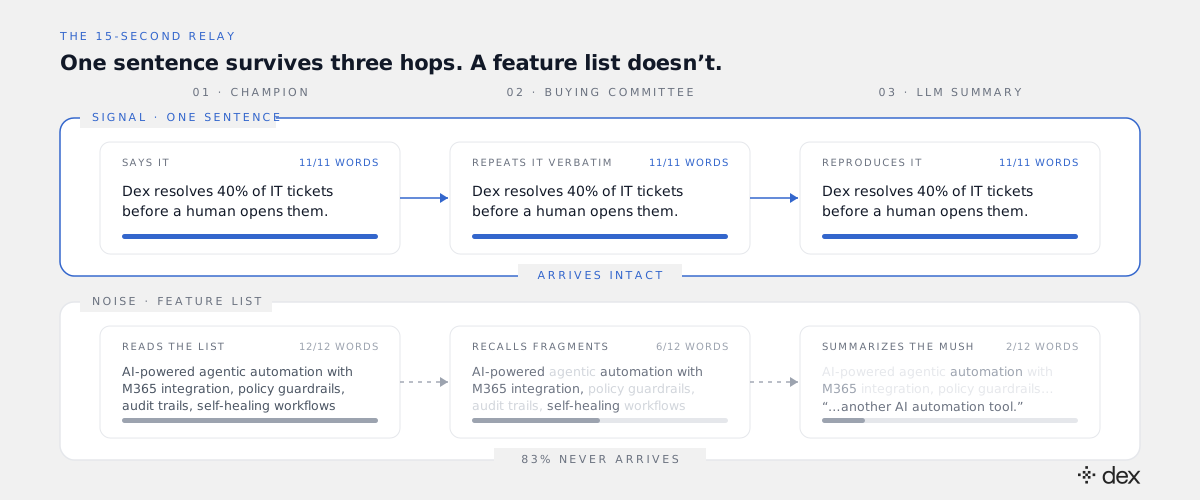
Here is the sentence:
"It's an autonomous IT engineer for Microsoft 365 — it resolves L1 through L3 requests end to end inside Teams, under our policies, with a full audit trail."
Twenty-six words. Roughly fifteen seconds spoken. Break it down:
Category: which shelf
"An autonomous IT engineer for Microsoft 365." Not a copilot, not an assistant, not a platform. A listener who has never heard of the category still knows what an engineer does: an engineer does the work. This clause exists to stop the substitution before it starts — it gives the relay something concrete to carry so the brain doesn't reach for "chatbot."
Scope: how much leaves
"Resolves L1 through L3 requests end to end." This is the clause that most often gets dropped, and dropping it is the expensive mistake. A tool described as L1 deflection gets evaluated against self-service password reset — a commodity with a commodity budget. A system that resolves through L3 gets evaluated against senior engineer capacity, which is a different budget line and a different conversation entirely. "End to end" is load-bearing too: it distinguishes resolving the request from routing it somewhere.
Boundary: the security answer
"Under our policies." Two words that answer the question the security lead was going to ask in the meeting you're not in. Every action must match an explicit policy; no policy, no action — and that's enforced at the execution layer, not in a prompt. Champions who can't say this clause get sent back to ask, which costs a week and a half of calendar time.
Proof: why it holds up
"With a full audit trail." This is the clause for the auditor, the compliance reviewer, and the CIO who has to defend the decision six months from now. It turns autonomy from a risk into something reviewable.
For a version aimed at employees rather than IT — the Dex Go product page covers this surface — the compressed form is shorter: "You ask IT for something in Teams and it's done, usually before anyone opens a ticket."
Why the feature list always loses the relay
The instinct when a champion asks "how do I explain this?" is to send more material. A one-pager. Six bullets. The deck.
Six bullets survive zero hops. Under time pressure a human repeats one thing, and if you gave them six, the one they repeat is whichever was most concrete — usually a feature, usually the least strategic one. "It does password resets" is a true sentence about Dex and a catastrophic relay, because it invites the committee to price the product against a password reset tool while ignoring the two tiers of work above it.
The failure mode isn't that the champion forgets. It's that they remember the wrong 10%.
One sentence with four load-bearing clauses beats six bullets, because the clauses reinforce each other. Drop one and the sentence sounds incomplete, which prompts the speaker to reconstruct it. Drop a bullet from a list and nobody notices, least of all the person listening.
The LLM is now a stakeholder in the room
There's a second relay running in parallel, and it's newer.
Before a committee meeting, at least one stakeholder is going to ask ChatGPT, Claude, or Google's AI Overview to summarize the vendors on the shortlist. That model does exactly what the human relay does — compresses available material into a phrase — with the same bias toward the most generic available category.
The inputs are your site, your docs, third-party mentions, and whatever your team has published. If those sources describe the product four different ways, the model resolves the inconsistency the same way the committee does: it picks the safe, generic label. "AI chatbot for IT support." That label then enters the meeting as a neutral third-party summary, which carries more weight than anything the champion says, because nobody thinks the model has a quota.
Consistency across your public surface isn't a brand-hygiene concern anymore. It's how you avoid getting misfiled by the system assembling the shortlist. The same drift that loses the human relay loses the machine one.
The three-hop test
Run this on a live deal this quarter. It takes twenty minutes and it's uncomfortable, which is the point.
Hop one. Ask your champion to explain the product in one sentence, no slides, no notes. Write down exactly what they say.
Hop two. Ask a second stakeholder — someone who heard about it from the champion and never met you — to explain it. Write that down too.
Hop three. Ask an LLM to summarize the vendor in one line, cold.
Then check three things. Did the category word survive? Did the L1-through-L3 scope survive, or did it collapse to "tickets"? Did the policy clause survive? If the category word held at every hop, the message is doing its job. If "autonomous IT engineer" arrived at hop two as "that AI helpdesk thing," the sentence is too long, too abstract, or too full of clauses that aren't load-bearing — and no additional collateral fixes that. Only a shorter, more concrete sentence does.
Most teams discover the drift starts at hop one.
What this means for the evaluation you're running now
If you're an IT leader evaluating agentic IT, this cuts both ways, and the second way matters more to you.
Your committee is going to compare three vendors on the basis of secondhand sentences. Some of those sentences will be generous to products that don't deserve it, and some will undersell products that do. The defense is to force each vendor into one falsifiable sentence and then test it — the three questions that separate agentic IT from chatbot copilots are the version of that test we'd run ourselves: does it investigate the real environment, does it execute against the real backend, and is every action bound to an explicit policy.
A vendor whose sentence can't be checked against those three questions has given you a slogan. A vendor whose sentence survives all three has given you something your champion can carry into a room you'll never see.
That's the whole job of the relay sentence. Not to win the demo. To win the meeting nobody invited you to.
Frequently asked
- How do you explain agentic IT to stakeholders in one sentence?
- Use a sentence built from category, scope, boundary, and proof: "It's an autonomous IT engineer for Microsoft 365 — it resolves L1 through L3 requests end to end inside Teams, under our policies, with a full audit trail." Category tells the listener what shelf it sits on. Scope tells them how much work it takes off the team. Boundary answers the security question before it's asked. Proof tells them it's auditable. Every clause is doing a job for a different seat on the buying committee, which is why the sentence survives being repeated by someone who wasn't in the demo.
- Why does the champion's explanation matter more than the sales pitch?
- Because most of the buying journey happens without the vendor. Gartner's B2B buying research puts total time spent with all potential suppliers at roughly 17% of the purchase cycle — split across three vendors, that's about 5% each. The other 95% is internal: hallway conversations, a Slack thread, a ten-minute slot on a steering committee agenda. In those rooms the champion is the only spokesperson the product has, and whatever sentence they use is the entire pitch.
- What happens when the website message and the sales message don't match?
- The buying committee resolves the contradiction by picking the safer, smaller interpretation — usually the one that classifies the product as a lower-risk, lower-value tool. Gartner's 2026 buyer research found 69% of buyers reported a mismatch between what a vendor's site said and what the sales team said. The cost isn't confusion; it's downgrade. A product described inconsistently gets filed under whatever category requires the least explanation to approve.
- Does the way we describe agentic IT affect how AI tools summarize us?
- Yes. When a stakeholder asks ChatGPT, Claude, or an AI Overview to summarize a vendor before a meeting, the model compresses whatever it can find into a phrase or two. Inconsistent source material compresses toward the most generic available category — "AI chatbot" or "ticket deflection tool." A site, a deck, and a champion all using the same concrete sentence give the model one thing to compress, and the summary comes back as "autonomous IT engineer that resolves L1–L3 in Microsoft 365 under policy." Same drift, two victims.
- Does Dex only handle Tier 1 tickets?
- No. Dex resolves L1 through L3 autonomously — routine Tier 1 work like password resets, MFA recovery, group access and provisioning, and also Tier 2 and Tier 3 work: multi-step configuration changes, deeper troubleshooting, and engineering-adjacent operations that used to require a senior tech. Only genuine architecture and judgment calls escalate to a human, and those arrive with full investigation context attached. Describing Dex as an L1 deflection tool understates the scope by two tiers, and it is the single most common way the relay sentence gets downgraded.
- How do I test whether our internal message actually survives being repeated?
- Run a three-hop test. Ask your champion to explain the product in one sentence with no slides. Ask a second stakeholder who heard it secondhand to repeat it. Then ask an LLM to summarize the vendor in one line. If the category word survives all three hops unchanged, the message holds. If "autonomous IT engineer" becomes "AI helpdesk thing" by hop two, the sentence is too long or too abstract to carry, and the fix is the sentence — not more collateral.