

The 3AM Ticket Problem: What IT Leaders Lose to Overnight Downtime
After-hours IT support automation closes the overnight gap your dashboards hide - and what a 3am ticket really costs when nobody is on shift.
Somewhere in your organization last night, someone could not work. A warehouse supervisor locked out before a shift handover, a support engineer in Singapore who lost their MFA device, a finance analyst closing the month at 2am who could not open the SharePoint site. Each of them filed a ticket and went to bed, and each ticket sat in the queue until the morning shift arrived. Nothing in your service desk dashboard flagged a problem, because the dashboard was not measuring the hours nobody was working.
That gap is the most expensive line item in IT that never appears on a report. This post covers why after-hours latency stays invisible in standard reporting, how to measure what it actually costs your organization, and what after-hours IT support automation has to do before it counts as coverage rather than a night-shift substitute.
Your dashboard is measuring the wrong clock
Most service desks report response and resolution time against staffed hours. It is a reasonable convention for managing a team and a terrible one for understanding the business impact.
A ticket submitted at 3:02am and picked up at 9:05am reads as a three-minute response in a business-hours SLA. The clock was paused. The user was not. From the user's side, that is six hours of being unable to do the job they are paid for, and the two numbers are extracted from the same ticket record. One of them describes your team's discipline. The other describes what the outage cost.
Two other reporting habits hide the same gap. Averaging time-to-resolution across all tickets buries the overnight cohort inside a much larger daytime population, so the mean barely moves. And plotting ticket volume by created timestamp against volume by resolved timestamp on the same axis makes the pattern obvious in about thirty seconds: a steady overnight trickle of arrivals, then a wall of resolutions stacked between 9am and 11am. That wall is queue, not work.
The number to pull
Export the last 90 days of tickets. Filter to submissions outside staffed hours. Measure time-to-resolution in wall-clock hours from submission, ignoring SLA pauses, and multiply the total by a fully-loaded hourly employee cost. Most IT leaders running this for the first time find that after-hours submissions are a modest share of volume carrying a wildly disproportionate share of total user downtime. It is a fifteen-minute analysis and it is usually the strongest number in the business case.
Why now: the workforce stopped keeping your hours
The 3am ticket used to be an edge case worth ignoring. Three shifts in the workforce made it structural.
Distributed teams. A single time zone for a company is now the exception. Your 3am is a colleague's 11am, and their blocker is a full working day lost, not an inconvenient night.
Shift-based operations. Manufacturing, logistics, healthcare, retail, and support organizations run people around the clock. For a nurse starting at 11pm or a supervisor opening a distribution center at 4am, "IT is back at nine" means the shift runs degraded or does not run.
Self-service as the baseline expectation. Employees resolve their own banking, travel, and payroll issues at midnight without asking anyone. IT is now the only internal function that still answers with a queue position, and it is measured against everything else people use.
The result is that 24/7 availability shifted from a differentiator to a floor. Roughly 70% of the week falls outside a standard business day. Any function that only operates in the other 30% is unavailable most of the time.
One ticket, two timelines
Here is the concrete shape of the problem, using the case that arrives more than any other overnight: an account lockout after repeated failed sign-ins.
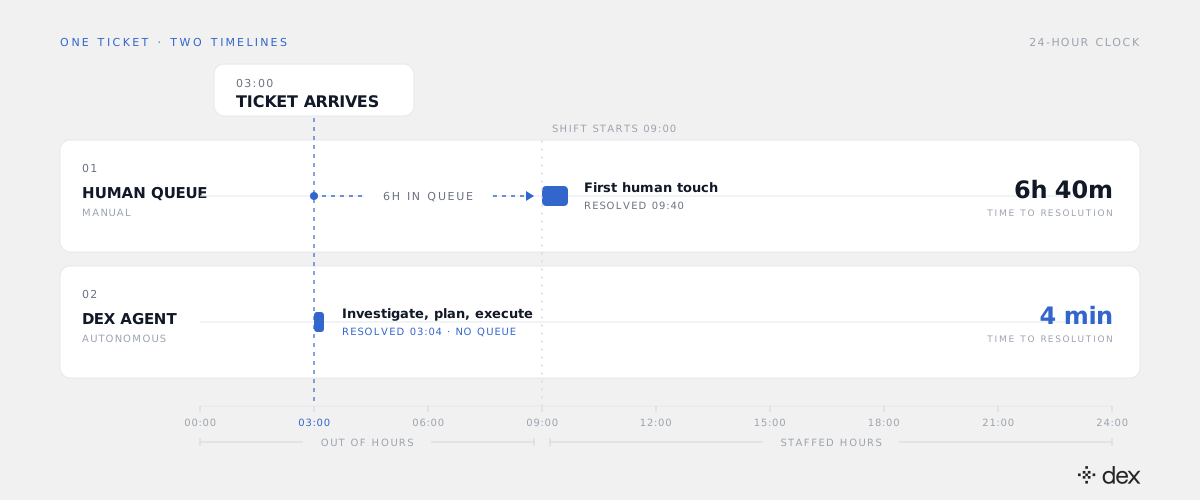
The human queue. The ticket lands at 03:00. It waits six hours for the shift to start, gets triaged, and resolves at 09:40. Total time to resolution: 6 hours 40 minutes, of which roughly six minutes was work. Everything else was waiting.
The autonomous path. The same request arrives at 03:00 in Microsoft Teams. Dex investigates the account state in Entra ID, confirms the lockout cause and the requesting user's identity, plans the remediation against the policy that governs it, executes the unlock and the credential reset, verifies the user can sign in, and logs every step. Resolved at 03:04. No ticket was ever created, so nothing entered the morning queue at all.
The mechanism matters more than the four minutes. The user did not get told what to try. The work got done, against the real system, under policy, with an audit trail. That is the distinction between an answer and a resolution, and overnight is where the difference is most expensive.
Why the usual after-hours fixes don't close the gap
Three approaches dominate, and each moves the cost rather than removing it.
The on-call rotation. The cheapest to set up and the most expensive to keep. It converts a payroll cost into an attrition cost, and it is unpopular for a reason: the pages that wake engineers are overwhelmingly routine, so senior people lose sleep over lockouts. Response is measured in tens of minutes at best, because someone has to wake up, get to a laptop, and load context.
Follow-the-sun coverage. Genuinely effective, and available to organizations large enough to staff a second and third region. It also multiplies the handoff problem: more shift boundaries means more context lost in transit, and it does nothing for the hours that fall between your regions.
Self-service portals and chatbots. These handle the narrow slice where the user has everything they need and only lacks instructions. Self-service password reset covers the clean case and stops at MFA loss, repeated-failure lockouts, resets requiring approval, and anything touching Conditional Access. A response that ends in "here is the article" or "a technician will follow up" is a deferral with better formatting. The ticket still waits for a person.
The common flaw is that all three keep human labor in the critical path for work that does not require human judgment. That is the same structural problem daytime queues have, which we laid out in L1 is a tax. Overnight simply removes the one thing that made it survivable during the day: a person on shift.
What after-hours IT support automation has to do to count
The bar is not availability, it is execution. Four properties separate real coverage from a night-shift costume.
It executes, it does not advise. The system performs the change in Microsoft 365, Entra ID, Exchange Online, Intune, or the SaaS platform in question, and confirms the outcome. If a human has to do anything the next morning for the request to be complete, the overnight gap was not closed.
It spans L1 through L3. Password, MFA, and access work is table stakes. Overnight, the harder cases are the ones with no fallback: a mail-flow failure, a licensing block, a device compliance policy preventing sign-in. Dex resolves L1 through L3 autonomously, which is what makes unattended hours viable rather than merely staffed by software.
It is bounded by explicit policy. Autonomy without governance is not something any IT leader should run unsupervised at 3am. Every Dex action must match a structured policy across a six-layer model, enforced at the code level rather than by prompt instruction. No policy, no action. Dex Go, the employee-facing product, is additionally scoped so it can only act on the requesting user's own account, never on anyone else's.
It leaves a full audit trail. Every step is recorded in both the Microsoft 365 logs and Dex's own activity log. The morning review question is not "what happened overnight" but "here is exactly what happened overnight," which is also the only version that survives an audit.
What you get back, and what you still keep
The immediate return is the downtime that stops accruing between the last technician logging off and the first one logging on. For distributed and shift-based organizations, that is the majority of the week.
The second-order return is what the day team stops absorbing. Overnight arrivals no longer pile into a morning queue, so the first two hours of the shift stop being a backlog sprint. Dex's target is 90%+ end-to-end autonomous resolution, and end-to-end is the operative qualifier: requests investigated, executed, and closed, not deflected to an article. Cliff DuPuy, Director of IT at Grand Traverse County, described the effect of that reclaimed capacity plainly: "Dex helped us unlock $67K in value in a single day."
What you keep is the on-call rotation, for the cases that genuinely need a human: tenant-wide outages, suspected compromise, business decisions, and anything no policy covers. Escalations arrive with the investigation already attached, so the engineer who wakes up starts from context instead of from questions. MSPs facing the same problem across a fleet of client tenants will find the economics worked out in what 24/7 coverage really costs an MSP.
What to do Monday
Pull the 90-day export and plot arrivals by created timestamp against resolutions by resolved timestamp. Isolate the after-hours cohort, re-measure it in wall-clock hours, and price it against a loaded employee rate. Then sort those tickets by type and ask a narrower question than "should we automate IT?": of the requests that arrived while nobody was working, how many needed a human at all?
For most organizations the honest answer is a small minority. The rest waited six hours for four minutes of work, and the only reason it took six hours is that the work required someone to be awake.
Frequently asked
- What is after-hours IT support automation?
- After-hours IT support automation means the routine IT work that arrives outside staffed hours gets resolved without waiting for a person to come on shift. The weak version is a knowledge base or a chatbot that tells the user what to try and leaves the actual change for the morning queue. The strong version is an autonomous IT engineer that investigates the issue, plans the change, executes it against the real system under an explicit policy, and writes an audit trail - at 3am, with no human in the loop and no ticket opened.
- Why doesn't our MTTR show an after-hours problem?
- Because most service desks measure the response clock against staffed hours. A ticket filed at 3am that a technician picks up at 9:05am is often recorded as a five-minute response, since the SLA clock was paused overnight. The user experienced six hours of downtime. Both statements come from the same ticket record, and only one of them is what the business paid for. To see the real number, re-measure time-to-resolution in wall-clock hours from submission, not in business hours.
- How do you cover 24/7 IT support without hiring a night shift?
- Genuine round-the-clock staffing is expensive because roughly 70% of the week falls outside a standard business day, and covering it takes multiple technicians once you account for holidays, PTO, and shift relief. The alternative is not a thinner rotation, it is removing the dependency on human labor for the work that does not need judgment. When routine L1 through L3 requests resolve themselves under policy, the on-call rotation stops absorbing lockouts and gets reserved for real incidents.
- Does Dex resolve more than password resets overnight?
- Yes. Dex autonomously resolves L1 through L3: password, MFA, lockout, and access requests, and also deeper Tier 2 and Tier 3 troubleshooting, mailbox and licensing problems, and configuration work that used to require a senior engineer. That range matters most overnight, because the tier that historically justified waking someone up is exactly the tier a single on-call engineer is least equipped to handle alone at 3am.
- What still needs a human at 3am?
- Tenant-wide outages, suspected account compromise and other security incidents, anything requiring a business decision, and anything with no policy covering it. Dex enforces no policy, no action at the code level, so an uncovered case stops rather than improvises. You still keep an on-call rotation. The difference is what triggers it: real incidents every few days instead of lockouts several times a night, and every escalation arrives with the full investigation attached.