

Dex for MSPs is live: what we will show on July 8
Dex for MSPs is generally available now. On July 8 we onboard a client tenant in 4 minutes and watch Dex resolve real L1 to L3 tickets live.
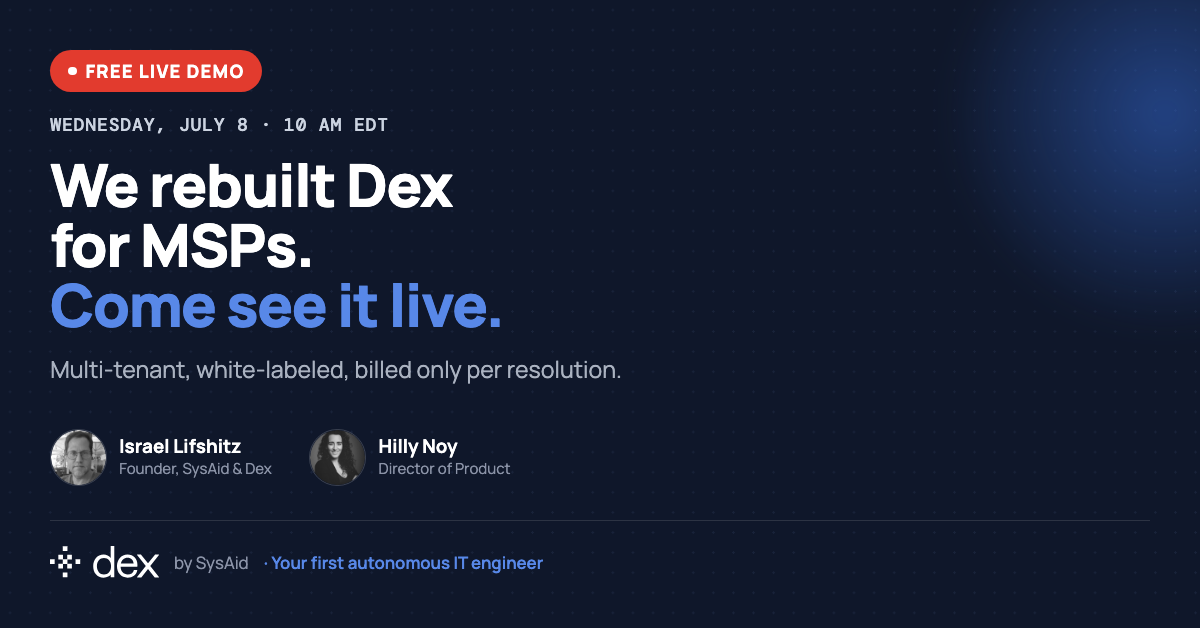
Dex for MSPs is generally available today, and on July 8 at 10:00 AM EDT we are going to show exactly what that means in a live walkthrough. This is not a coming-soon teaser. Israel Lifshitz, founder of SysAid and Dex, and Hilly Noy, Director of Product at Dex, will onboard a new client tenant in about four minutes, then put Dex Go in front of real client tickets and let it work. The reason this matters for an MSP is simple: your margin lives or dies on L1 labor, and Dex removes that work instead of routing it. This post previews what is on screen on July 8 and why each piece changes the unit economics of running an MSP.
Why this is an MSP problem first
Every MSP runs the same arithmetic. You win a new client, the ticket volume arrives, and the only way to serve it is to add a technician or burn out the ones you have. L1 work is the largest slice of that volume and the lowest-margin slice, because it is repetitive, interrupting, and priced into a flat monthly retainer that does not flex when a client has a bad week. The more clients you sign, the more L1 labor you absorb, and the thinner each contract gets.
Dex breaks that link. Dex is the world's first autonomous IT engineer for Microsoft 365: it investigates the root cause, plans the right sequence of actions, and executes real operations inside the client's environment, without opening a ticket. When the routine work resolves itself, the headcount you would have hired to serve the next ten clients is no longer the cost of growth. That is the whole pitch, and on July 8 we demonstrate it against live tenants rather than slides. For the longer argument on the economics, see our breakdown of how MSPs scale IT support without adding headcount.
Onboarding a client tenant in four minutes
The first thing we show is onboarding speed, because for an MSP it is the difference between a sales motion and a services project. Dex connects to a new Microsoft 365 tenant using delegated permissions, which means the client admin grants consent with their own OAuth token. There is no shared API key with broad access, no credential vault to build, and no multi-week provisioning engagement.
On July 8 we onboard a fresh tenant from a cold start and time it. It runs around four minutes. By the end of those four minutes, Dex is connected, policy-scoped to that tenant, and ready to act. Multiply that across a book of clients and onboarding stops being the bottleneck that holds up a rollout.
Dex Go resolving real tickets, L1 through L3
Onboarding is the setup. The payoff is watching Dex Go resolve actual client requests live. Dex Go lives natively inside Microsoft Teams and Slack, so the client's employees just describe the problem the way they would to a colleague, and Dex does the work.
The number we hold ourselves to is 90% autonomous resolution, end-to-end, across the L1 to L3 surface. That last part is the point most "AI for IT" pitches quietly skip. Dex is not a Tier 1 deflection bot. It handles the routine L1 cases, password resets, MFA recovery, group and license access, software provisioning, and it also handles the deeper L2 and L3 work: multi-step configuration, troubleshooting that used to require a senior engineer, the engineering-adjacent tasks that have always been the reason you could not fully automate the queue. Up to 40 reasoning steps per task means Dex does not give up at the first error. Only genuine architectural or judgment calls escalate to a human, and they escalate with full context attached.
"Resolves end-to-end" is the qualifier that matters. Pointing a user at a knowledge-base article is not a resolution. Performing the action, under policy, with a full audit trail, is. That is what is on screen on July 8.
White-label per tenant, one control plane
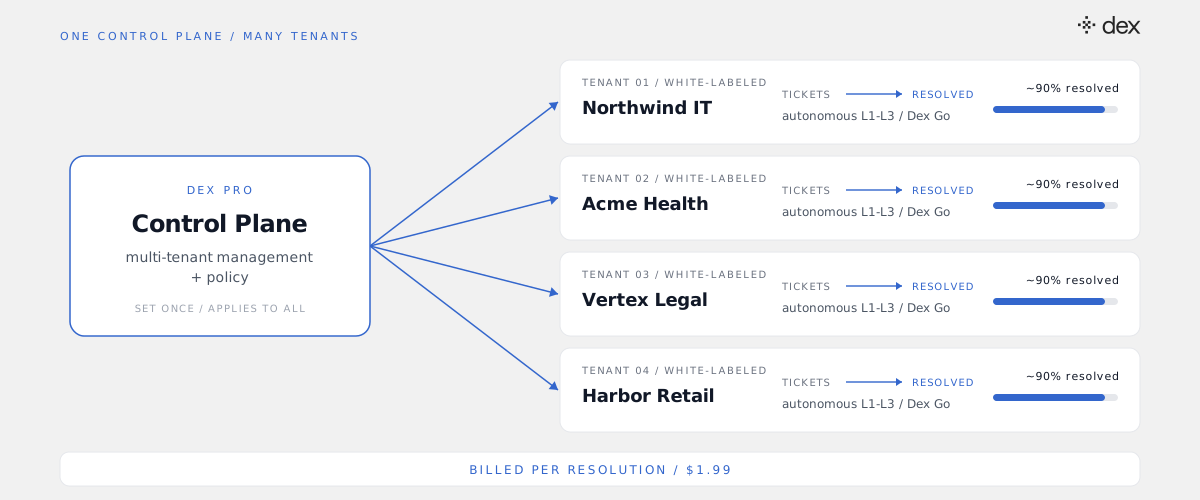
An MSP cannot run on a tool that puts a vendor's name in front of the client. Dex is white-label per tenant, so each client experiences your brand inside their own Teams and Slack, not ours. To them, the autonomous engineer is yours.
Behind that, you manage every tenant from a single control plane. Dex Pro is the admin console where your team supervises and operates across all client environments at once. Each tenant is isolated, with its own policy set, its own data boundaries, and its own audit log. Dex Pro uses the admin's delegated permissions, shows every action before executing, and offers an "Approve Always" option for bulk operations, so governance scales with you instead of becoming the thing that slows you down. Every action must match an explicit policy. No policy, no action, enforced at the code level rather than as a prompt instruction.
On July 8 we switch between tenants in the Dex Pro view so you can see what multi-tenant management actually looks like: one pane, many clients, full separation.
Pricing that maps to your team, not your clients
The pricing model is the part MSPs tend to lean forward for, because it is built for the way you actually scale. Dex is priced per technician, meaning the people on your team who operate Dex. Not per client. Not per end-user. Standard is $89 per technician per month billed annually ($107 monthly). Max is $189 per technician per month billed annually ($228 monthly) and carries 3x the resolution capacity. Every plan includes the whole product, so plans differ only in how much Dex resolves, never in what it can do. Enterprise is custom.
That alignment is the point. Your cost is a small, fixed function of the handful of technicians running Dex, while the client employees Dex helps never need a license at all. You onboard a new client without adding a per-seat line item, so the resolution capacity you deliver grows without your cost growing with it. You know your cost per technician, you know your price per client, and the spread is your margin.
And you can start free for 30 days with no credit card. That covers a meaningful run of real client tickets before any spend, so you can prove the resolution rate on your own clients' work rather than taking the 90% number on faith.
What to expect on the call
The walkthrough is built to be watched by an operator, not a buyer in the abstract. The agenda is the spine of this post, run live: onboard a tenant in about four minutes, send real tickets through Dex Go and watch it resolve across L1 to L3, move through the Dex Pro multi-tenant console, and walk the per-technician pricing against an example client book. Israel and Hilly host, and there is time for the questions that decide whether this fits your stack, the PSA and RMM integrations, the policy model, the escalation behavior on the hard cases.
Dex is built by the team behind SysAid, trusted by more than 3,000 organizations, whose platform is ISO 27001 and SOC 2 Type 2 certified; Dex is built to those same standards (its own certifications are in process), with GDPR and HIPAA-aligned controls. The credibility is not the reason to come. The reason to come is that this is shipping now, and you can see it work on a real tenant in under an hour.
Register for July 8
The Dex for MSPs live walkthrough is July 8 at 10:00 AM EDT, hosted by Israel Lifshitz and Hilly Noy. If you run an MSP and you have been waiting to see autonomous IT do the work rather than describe it, this is the session.
Register at dex365.ai/july-8. Bring the client you would onboard first.
Frequently asked
- When is the Dex for MSPs live walkthrough?
- July 8 at 10:00 AM EDT. It is a live walkthrough hosted by Israel Lifshitz, founder of SysAid and Dex, and Hilly Noy, Director of Product at Dex. You can register at dex365.ai/july-8. Dex is already generally available, so the session demonstrates what ships today, not a roadmap.
- How long does it take to onboard a new client tenant?
- About 4 minutes. Onboarding uses delegated permissions through the admin's own OAuth consent, so there is no shared API key and no long provisioning project. We onboard a fresh tenant live on July 8 so you can time it yourself.
- What resolution rate does Dex actually achieve for MSP clients?
- Dex resolves roughly 90% of incoming requests end-to-end across the L1 to L3 surface, without escalating to a human. That includes routine L1 work like password resets and access, and deeper L2 to L3 troubleshooting, configuration, and engineering-adjacent tasks. Only genuine architectural or judgment cases escalate, with full context attached.
- How does Dex pricing work for MSPs?
- Dex is priced per technician, meaning the people on your team who operate Dex, not per client and not per end-user. Standard is $89 per technician per month billed annually ($107 monthly), and Max is $189 per technician per month billed annually ($228 monthly) with 3x the resolution capacity. Every plan includes the whole product; they differ only in capacity. The client employees Dex helps never need a license. You can start free for 30 days with no credit card, so you can run real client tickets through it before a single dollar comes out of pocket.
- Can each MSP client be white-labeled separately?
- Yes. Dex is white-label per tenant, so each client sees your brand, not ours. You manage every tenant from a single Dex Pro control plane, with per-tenant policy, isolation, and audit trails. We show the multi-tenant view live on July 8.