

The $67,000 day: what Grand Traverse County's IT team did while Dex did the work
The ROI of IT automation, told through one day: how Grand Traverse County unlocked $67,000 in value while Dex did the Microsoft 365 work.
When you ask "what's the ROI of IT automation?", most answers hand you a formula: ticket volume times cost per ticket times deflection rate. The formula is real, but it measures the wrong thing — it counts the cost you remove, not the value you unlock. Cliff DuPuy, Director of IT at Grand Traverse County, gave the number that actually matters: "Dex helped us unlock $67K in value in a single day." This post is about what that day was, why $67,000 is the right way to think about agentic IT ROI, and what your own team would do with the hours it gets back.
The number that matters isn't the one on the invoice
The standard ROI pitch for IT automation is a subtraction problem. Take the work the tool removes, multiply by what each unit of work cost, and call the difference your savings. By that math, automating a few hundred password resets a year saves a few thousand dollars — real, but not the kind of number that changes how a department is run.
That framing misses the larger half of the equation. The cost of routine IT work was never just the labor to resolve it. It was the opportunity — the migration that didn't happen, the security review nobody had time for, the customer project quoted at retail because the team was buried in the queue. When the routine work disappears, that opportunity comes back. The $67,000 Cliff DuPuy described isn't money saved on help-desk overhead. It's value the team produced once the queue stopped owning their attention.
That's the distinction worth holding onto: labor saved is a small, visible number; output unlocked is a large, mostly-invisible one. For an MSP like Grand Traverse, the unlocked output is especially concrete, because recovered engineering hours convert straight into billable capacity.
Who Cliff DuPuy is, and why an MSP makes the number legible
Grand Traverse County runs a managed service operation — its IT team serves environments beyond its own four walls. That matters for the ROI story, because in an MSP every engineering hour has a price tag. An hour spent resetting a password is an hour not spent on work a client would pay for. So when the routine load lifts, the recovered time doesn't just feel productive — it shows up as revenue capacity the team can actually quote.
That's why the single-day figure is as large as it is. In a typical internal IT department, recovered hours turn into deferred projects finally getting done. In an MSP, they turn into billable engineering on top of that. Same mechanism — the routine queue stops consuming senior people — but the value is easier to count when there's a rate card attached to it. The full version of this dynamic is the MSP playbook for scaling IT support without hiring; Grand Traverse is what that playbook looks like on a single Tuesday.
What the day actually looked like
Here's the shape of the day, and it's worth being precise about who did what.
The morning starts the way every IT morning starts: a stack of open Microsoft 365 issues. Accounts locked out overnight. A new hire who needs five group memberships before a 9 a.m. meeting. A shared mailbox that stopped delivering. A license that needs reassigning. A Conditional Access policy quietly blocking a contractor. None of these are hard. All of them are interrupting. Each one, handled the old way, is a context switch that pulls a senior engineer out of real work for ten to forty minutes.
Dex takes that stack. For each issue, it does three things: it investigates the actual state of the Microsoft 365 environment, it plans the sequence of actions that resolves the issue, and it executes that plan — the real change, against the real tenant, under an explicit policy. Not a suggestion. Not a drafted response for a human to send. The access gets granted, the license gets assigned, the mailbox gets fixed. No ticket is opened, because the issue is gone before a ticket would have been.
Crucially, this isn't only the easy tier. Dex resolves L1 through L3 — the password resets and access changes, yes, but also the multi-step Tier 2 troubleshooting and the Tier 3 configuration work that used to require the most senior person in the room. Only genuine architectural or judgment calls escalate, and they escalate with the full investigation already attached, so the human picks up context instead of starting cold.
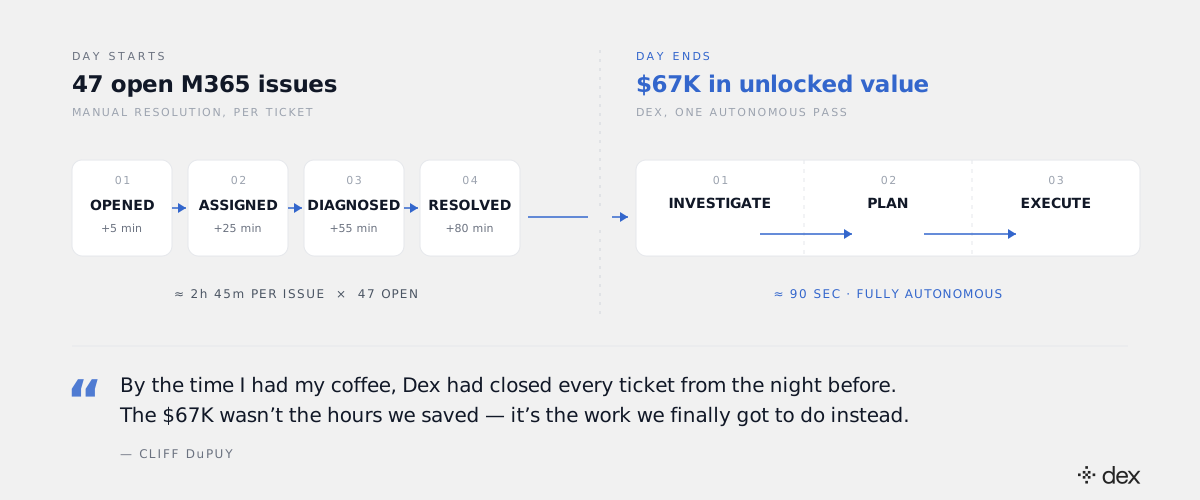
While Dex worked the queue, the engineers did something they rarely get a clean run at: their actual job. That's the half of the day that produced the $67,000 — not the absence of tickets, but the presence of senior people doing senior work for an uninterrupted stretch.
Why "value unlocked" beats "tickets deflected" as a metric
Plenty of tools will quote you a deflection rate. Be careful with the word, because three very different numbers hide behind it.
Containment is the share of requests that don't reach a human — including the ones a chatbot "handled" by pointing the user at a knowledge-base article they then ignored. It's the easiest number to inflate and the least meaningful.
Self-service is the share of users who fix their own problem through a portal. Useful, but the credit belongs to the user, and most organizations already had a decent self-service rate before they bought anything.
End-to-end resolution is the share of requests the system resolves itself — investigates, plans, executes against the real backend, closes with an audit trail. This is the only one that maps to value. Dex's number here is 90%+ across the Tier 1 surface, and it extends up through L3.
The reason "value unlocked" is the better headline metric is that it skips the definitional games entirely. You can argue about what counts as a deflection. You can't argue with $67,000 of work the team got to do. Cliff DuPuy didn't report a containment rate. He reported what his department produced.
The governance that makes this safe to run unattended
A reasonable IT director reads "executes real changes against the tenant, unattended" and tenses up. That reaction is correct, and it's exactly what the policy engine is built for.
Every action Dex takes must match an explicit, structured policy. No matching policy means no action — and that's a hard block at the code level, not a politely-worded instruction in a prompt that a clever input could talk its way around. Dex acts through delegated permissions, scoped to what the policy allows, never through a broad shared API key. It never bypasses MFA and never grants itself admin roles. Every action lands in both the Microsoft 365 logs and Dex's own activity log, so the entire $67,000 day is auditable line by line.
This is what lets the work run without a human watching each step: the autonomy is real, but it's governed autonomy. The engineer who used to approve each change now writes the policy once and reviews the trail — a far better use of a senior person's judgment than clicking "approve" forty times a morning. For IT admins who want that policy-and-console layer over Microsoft 365, Google Workspace, and any SaaS, that's Dex Pro, the admin console for agentic IT operations.
What your team would do with the hours back
The honest way to size this for your own organization isn't to copy Grand Traverse's number — it's to ask the question their number answers: what does our IT team produce when it isn't doing the routine work?
Make a short list. The migration that's been "next quarter" for three quarters. The security posture review. The integration that would save another team ten hours a week. The documentation debt. For an MSP, the billable engineering you've been turning down because there's no one free to do it. Put a rough dollar figure on each. That total — not the help-desk line item — is the ROI of agentic IT.
The reason it lands as a single-day figure in Grand Traverse's case, rather than a slow annual drift, is that the change is immediate. The day Dex takes the queue is the day the team's hours come free. There's no ramp where the tool "learns your environment" for a quarter first; it investigates the environment as it goes, and it gets faster as its memory of your specific quirks builds.
So the takeaway for an IT leader making the case to a CFO is two sentences. The labor savings are real but small, and they'll see those on the invoice. The unlocked output is two to three times larger, it lives in every other team's results, and Grand Traverse County put a citable number on it: $67,000 in a single day.
Frequently asked
- What's the ROI of IT automation?
- The real ROI of IT automation isn't the help-desk labor it removes — it's the high-value engineering work the team produces once the routine queue stops owning their day. Cliff DuPuy, Director of IT at Grand Traverse County, put a concrete number on it: his team unlocked $67,000 in value in a single day after handing the routine Microsoft 365 work to Dex. That figure is recovered output — projects, billable engineering, deferred work — not money saved on ticket overhead. The labor-savings number is real but small; the recovered-output number is usually two to three times larger.
- What did Grand Traverse County's IT team do with Dex?
- Grand Traverse County, an MSP, used Dex to autonomously resolve its routine Microsoft 365 workload — the password resets, access changes, license assignments, and Tier 2-3 troubleshooting that normally consume an engineer's day. Dex investigates each issue, plans the fix, and executes it under policy without opening a ticket. With that queue handled, the team redirected its hours to higher-value work, which Director of IT Cliff DuPuy quantified at $67,000 of unlocked value in a single day.
- Is the $67,000 figure a real customer result?
- Yes. It's a direct, attributed claim from Cliff DuPuy, Director of IT at Grand Traverse County: "Dex helped us unlock $67K in value in a single day." Grand Traverse is a managed service provider, so the recovered hours convert directly into billable engineering capacity — which is part of why the single-day figure is as large as it is.
- Does Dex only handle Tier 1 / L1 tickets?
- No. Dex autonomously resolves L1 through L3 — routine Tier 1 work (passwords, MFA, access, provisioning) and deeper Tier 2-3 troubleshooting, configuration, and engineering-adjacent tasks that used to need a senior tech. Only genuine architectural or judgment calls escalate to a human, with full context attached. Describing Dex as 'L1 only' understates what it actually does.
- How is this different from a chatbot deflecting tickets?
- A chatbot answers questions and routes requests; it doesn't change anything in your environment. Dex executes real operations inside Microsoft 365 — it makes the access change, assigns the license, fixes the configuration — under an explicit policy engine with a full audit trail. The $67,000 came from work done, not tickets deflected to a knowledge-base article.