

When the CFO Vetoes: The Cost Math That Survives Procurement
The ROI of IT automation in the one block a CFO will actually read: avoided operational cost against a flat per-technician line, and why 49% of approved deals die.
The ROI of IT automation is one comparison, and a CFO will do it in about eleven seconds: what does it cost to resolve these issues today, and what does the new thing cost to resolve them at scale? Published benchmarks put a Tier 1 contact at $20 to $30 of operational cost and a Tier 2 contact at $50 to $100. Dex is priced per technician who operates it - a small, fixed line that does not move with ticket volume. That is the whole argument, and it is the only version of the argument that survives the room your champion was not invited to.
Everything else in the business case - the productivity narrative, the engineer-hours story, the transformation slide - is commentary that finance discounts by default. This post builds the block that isn't discounted: a total cost of ownership comparison a champion can paste into an email, forward to a CFO, and have survive contact with procurement. It matters right now because the deal no longer dies at discovery. It dies after approval, on cost and trust.
Why the veto moved to the end of the process
The purchase decision and the funding decision are two different events, and only the second one belongs to finance. G2's 2026 Buyer Behavior Report, based on 1,038 B2B software buyers surveyed in June 2026, found that 49% of buyers had a CFO veto an already-approved software purchase in the previous 12 months. Finance involvement in software decisions climbed from 31% to 46% over the same period.
Two more numbers from the same study explain why AI purchases specifically are exposed. Among organizations with a dedicated LLM or token budget, the veto rate rises to 54%. And concerns about internal resistance to AI adoption grew from 16% to 29% in a single year - the largest single-year shift in the entire study.
Read those together and the picture is not hostility. It is a finance function that has been surprised by AI spend before and has responded by moving its review to the last possible checkpoint. Your champion is now relaying a case to a reviewer who has already been burned by a category, not by you. We mapped the full relay problem in what a CIO's AI buying committee actually asks; this post is the finance seat's block, written to be forwarded.
What the CFO is actually objecting to
A CFO rarely vetoes a price. They veto a number they cannot forecast.
The distinction is worth being precise about, because it changes what evidence helps. If the objection were price, a discount would fix it, and discounts routinely fail to unstick these deals. The objection is usually structural: the cost cannot be forecast, the benefit is variable, and the reviewer has no way to bound the downside. A tool with a platform fee plus per-agent seats plus a metered AI add-on has a total that grows with two things a CFO cannot pin down: how many technicians end up with seats, and how much the AI tier gets used. Stack those and the annual number is genuinely unknown until the contract year is over.
That is an uncomfortable thing to defend in a fifteen-minute review, and champions usually try to defend it with upside - productivity gains, deflection rates, hours recovered. Upside arguments lose to unbounded downside every time. The move that works is to change the shape of the cost, not the size of it.
The two cost shapes, side by side
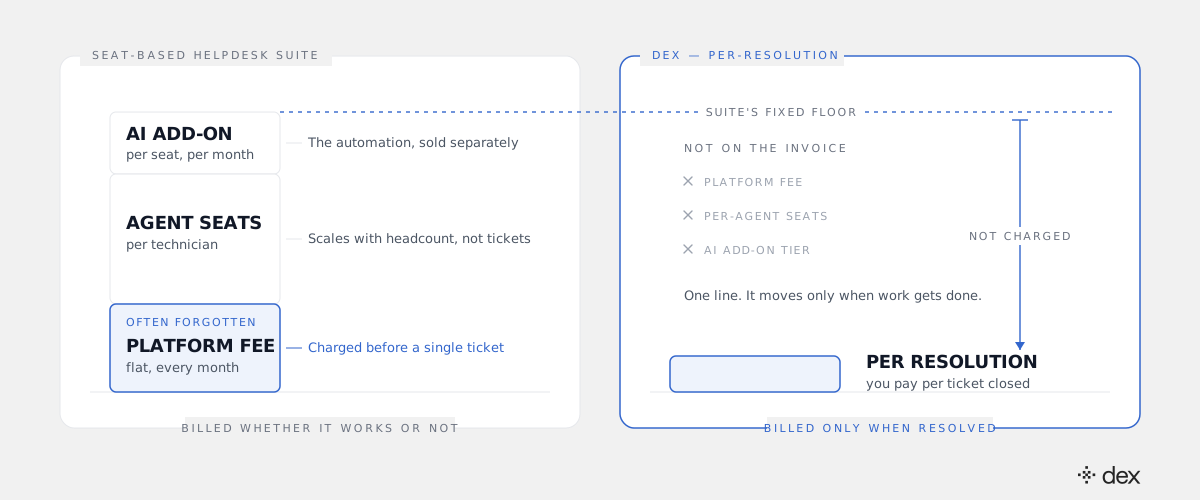
This is a comparison of pricing structures, not of vendors. The seat-based shape is common across the category and it is not inherently wrong - it is simply built from three layers that stack. A flat platform fee, charged before a single ticket is touched. Per-agent seats, one for every technician on your helpdesk, which scale with your support headcount. And a metered AI add-on tier, which is where the automation you are actually buying lives, sold on top of the other two and climbing with usage.
None of that is a scandal. It is just a total that grows with two moving parts. And a cost that grows with headcount and usage is exactly the object a CFO has learned to veto, because it converts an uncertain benefit into an uncertain liability.
Dex collapses those three layers into one. It is priced per technician who operates it - the small team that runs Dex, not a seat for every agent on your helpdesk - with the whole product on every plan and capacity as the only difference between tiers. There is no separate platform fee and no metered AI add-on. The line is $89 per technician per month on Standard, $189 on Max for three times the capacity, and it does not move when ticket volume rises or when the number of employees Dex helps grows, because those employees never need a license. To be fair about the trade: a flat line is not automatically the cheapest option at every volume. What it is, is knowable on day one, and knowability is what is being priced in that room.
One thing this comparison deliberately does not touch: your ITSM. The service desk platform you already own is the system of record, and its cost is not the line under review. What is under review is the automation layer bolted on top of it.
The forecastable TCO block
Here is the artifact. Replace the inputs with your own numbers, keep the structure, and send it as-is. It is built to be read by someone who will not open an attachment.
INPUTS (replace with your own)
  Employees                       500
  Tickets per employee per year     4      → 2,000 tickets/year
  Tier mix                        60% T1 / 30% T2 / 10% T3
  Loaded cost per contact         $25 T1 / $75 T2 / $200 T3
                                  (published benchmark range)
  Technicians operating Dex          3     (the people who run Dex)

TODAY - cost of the resolution path
  1,200 Tier 1  ×  $25   =  $30,000
    600 Tier 2  ×  $75   =  $45,000
    200 Tier 3  ×  $200  =  $40,000
                            ────────
                            $115,000   operational cost/year

WITH AUTONOMOUS RESOLUTION
  Resolved by Dex:
    90% of Tier 1   =  1,080 resolutions
    50% of Tier 2   =    300 resolutions   (conservative)
                       ─────
                       1,380 resolutions

  Avoided:   1,080  ×  $25     =   $27,000
               300  ×  $75     =   $22,500
                                  ────────
                                   $49,500

  Dex cost:  3 techs × $89/mo × 12  =   $3,204   fixed, whole product
                                                  (Standard, billed annually)

  NET (avoided minus Dex cost)          $46,296
  Effective cost per resolution           $2.32   falls as volume rises
  Dex line, fixed and known day one       $3,204   flat, not metered
  Cost to start                               $0   (free 30 days, no card)
Three properties make this block survive procurement. The Dex line is fixed and stated, so the reviewer can forecast it on day one. The trial is free, so the downside case is bounded. And every input is a number the organization already has, so nothing depends on trusting a vendor's model.
Deliberately absent: the loaded-cost multiplier. The real cost of a ticket runs three to five times the invoice cost once user wait time and engineer interruption are counted, and we have made that case at length in the IT helpdesk math. Leave it out of the forwarded block. A CFO who has never seen that argument will read it as inflation, and it costs you the credibility of the numbers that are load-bearing. Bring it to the second meeting, if there is one.
The three questions that come back
When the block lands, the reply is usually one of three questions. Your champion should have all three answers before they hit send.
"What am I committed to?" Start with nothing: Dex is free for 30 days, no credit card. After that it is a per-technician line sized to the small team that operates Dex - $89 per technician per month on Standard, $189 on Max - with the whole product on every plan and no separate platform fee or AI add-on. You can price it exactly on day one, and because the employees Dex helps never need a license, the number does not creep as adoption grows. The pilot's true cost is the integration time, not the software.
"What actually gets resolved, and can I verify it?" A resolution is an issue investigated, planned, and executed end to end against the real backend - Entra ID, Exchange Online, SharePoint, Intune - and closed. Not a deflection to a knowledge base article. Not a better-formatted ticket. Every action lands in both native Microsoft 365 logs and Dex's own Activity Log, so the work is auditable against the flat line you are paying - you can confirm the resolutions are real without taking a vendor's word for the count.
"What stops it doing something expensive?" Every action must match an explicit policy, enforced in the execution layer rather than in a prompt. No policy, no action. Dex never grants admin roles and never bypasses MFA, and Dex Pro runs on delegated permissions - the admin's own OAuth token, scoped to what that admin can already do - rather than a broad application key.
The scope assumption the whole model rests on
One line in the block does more work than the rest: the Tier 2 row.
Dex autonomously resolves L1 through L3, not L1 only. Routine Tier 1 work - password resets, MFA recovery, group and license access, provisioning - plus the deeper Tier 2 and Tier 3 troubleshooting, configuration, and engineering-adjacent tasks that used to need a senior technician. Genuine architectural and judgment calls escalate to a human with full context attached.
That scope is the difference between a good model and a marginal one. A Tier 2 resolution avoids $50 to $100 of operational cost against the same flat per-technician line. An L1-only tool - which is what most of the category ships - caps its own return at the cheapest tickets you have. When a reviewer asks why the savings number is what it is, the answer is scope, and it is worth checking that any tool you compare against actually clears the same bar.
What to do Monday morning
Rebuild the block above with your own inputs. Ten minutes with last year's ticket export gets you volume and tier mix; use the published benchmark range for cost per contact and say that you did.
Then send it to your champion with one instruction: forward this, don't summarize it. The summary is where the forecastability disappears, and forecastability is the entire product being sold to that room.
A CFO does not veto software. They veto a number they cannot forecast. Give them one they can, and the meeting you were not invited to stops being the one that kills the deal.
Frequently asked
- What is the ROI of IT automation?
- It is one comparison: the loaded cost of resolving your issues the way you resolve them today, against what the automation costs to resolve them at scale. Published benchmarks put a Tier 1 contact at $20 to $30 of operational cost and Tier 2 at $50 to $100. Dex is priced per technician who operates it - $89 per technician per month on the Standard plan, billed annually - not per resolution and not per employee helped, so the line is fixed and known on day one rather than a function of ticket volume. For a 500-person organization running 2,000 tickets a year, a small operating team produces roughly $49,500 in avoided operational cost against a fixed Dex line of about $3,200 - before any productivity recovery is counted.
- Why do CFOs veto software purchases that were already approved?
- Because the approval and the funding are two separate decisions, and only the second one is theirs. G2's 2026 Buyer Behavior Report, based on 1,038 B2B software buyers surveyed in June 2026, found that 49% of buyers had a CFO veto an already-approved purchase in the prior 12 months. Finance involvement in software decisions rose from 31% to 46% in the same period. The veto is almost never a judgment on the product - it is a judgment on a cost that could not be forecast.
- How do I calculate the cost per resolved IT ticket?
- Take the total annual cost of the resolution path - staff time, tooling, escalation overhead - and divide by the number of issues actually closed end to end, not tickets opened or deflected. Do the same for the automation you are evaluating. If a tool charges a platform fee plus per-agent seats plus a metered AI add-on, its total grows with both your headcount and your usage, so the annual number is unknown until the year is over. A flat per-technician line inverts that: the annual cost is fixed and known on day one, so the more the tool resolves, the lower the effective cost per resolution.
- Does Dex charge per seat, per user, or per resolution?
- None of those in the way you would expect. Dex is priced per technician who operates it - the small team that runs Dex - at $89 per technician per month on Standard or $189 on Max for three times the capacity, with the whole product on every plan. The employees Dex helps never need a license, and resolutions are not metered, so the line does not move with ticket volume or with the size of the organization you support. That is different from stacked per-agent-plus-usage pricing, where the total climbs with both your support headcount and how much the AI tier gets used.
- Does Dex only automate L1 tickets?
- No. Dex autonomously resolves L1 through L3 - routine Tier 1 work like password resets, MFA recovery, and access provisioning, plus deeper Tier 2 and Tier 3 troubleshooting, configuration, and engineering-adjacent tasks that used to require a senior technician. Only genuine architectural and judgment cases escalate to a human, with full context attached. The scope matters to the cost math: a Tier 2 resolution avoids $50 to $100 of operational cost, not $25, so an L1-only tool produces a materially smaller number.
- How do I pilot Dex without financial risk?
- Dex is free for 30 days with no credit card, so a pilot that resolves nothing costs nothing. After the trial it is a fixed per-technician line - $89 per technician per month on Standard - sized to the small team that operates Dex and known on day one, not a metered charge that surprises you and not a per-seat contract scaled to your whole helpdesk. Because the line does not move with resolution volume, you pay a known amount whether Dex resolves 8,000 issues or eight. The downside a finance reviewer actually prices is the trial, and the trial is a zero.